
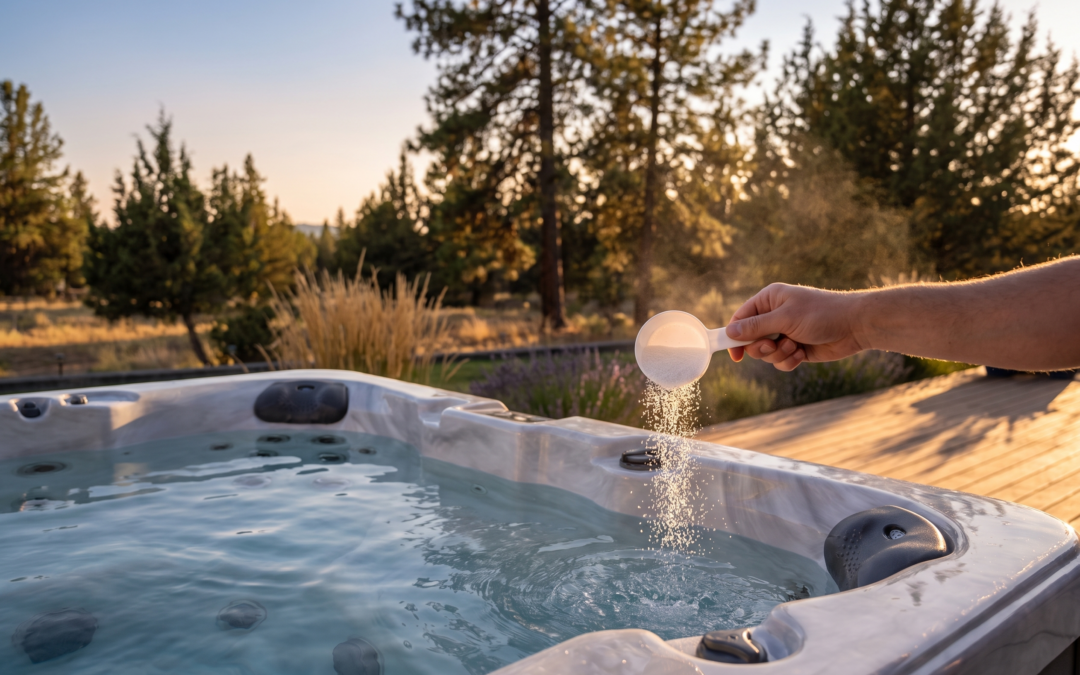
Hot tub sanitizer is the chemical that keeps your spa water safe to soak in. It works continuously to kill bacteria and other germs, which matters because warm water lets them multiply quickly.
Many owners assume clear water means clean water. It does not. Spa water can look perfectly clear and still be unsafe. The only way to know is to test it.
This guide covers the main types of hot tub sanitizer, which one we recommend and why, how much to use, how to test your water, and what a simple weekly routine looks like.
Key Takeaways
- Sanitizer is the only product that continuously kills bacteria. Shock, pH adjusters, and clarifiers support it but never replace it.
- Clear water is not automatically safe water. Only a test result tells you where your levels are.
- We recommend chlorine for most Central Oregon spas. It acts faster, costs less, and can be shielded from sunlight, which bromine cannot.
- Pair chlorine with a water conditioner. Spa Marvel and AquaFinesse cut how much chlorine your water consumes and leave it softer on skin.
- Balanced water works better. When pH drifts high, chlorine loses much of its killing power at the same reading.
- Consistency beats intensity. Testing a few times a week prevents more problems than one large correction after the water clouds.
What Is a Hot Tub Sanitizer?
A hot tub sanitizer maintains a continuous level of disinfectant in your spa, killing bacteria, viruses, and other microorganisms on contact. It helps to separate it from the products sitting beside it on the shelf:
- Sanitizer (chlorine, bromine, biguanide) kills living microorganisms and holds a protective residual at all times.
- Oxidizer, or shock, burns off non-living organic waste: sweat, body oils, lotions, and cosmetics.
- pH balancers raise or lower acidity so your disinfectant can perform.
- Clarifiers clump fine particles so your filter can catch them. They improve appearance, not safety.
- Mineral cartridges and ozonators reduce chemical demand, but supplement a sanitizer rather than replace one.
The key idea is the residual. This is not something you add when the water looks dirty. It has to be present beforehand, so that when someone steps in with bacteria on their skin, the water is already prepared. Dosing reactively is like installing a smoke alarm after you smell smoke.
Why Sanitizing Your Hot Tub Is Essential
Warm water is wonderful for your muscles and equally wonderful for bacteria. At spa temperatures of 100 to 104 degrees, microorganisms multiply far faster than in a cold pool and your chemicals burn off faster. That is why spas need more attention per gallon than any other water at your home.
Left unchecked, bacteria form biofilm, a slick layer inside jets, pipes, and filter housings where you cannot see or scrub it. Biofilm shelters bacteria from treatment, which is why a neglected spa seems to resist every chemical you add. Researchers estimate Pseudomonas aeruginosa is present in roughly two-thirds of hot tubs at any given moment.
The health consequences are real but preventable. The most common is hot tub folliculitis, an itchy rash appearing a day or two after soaking in under-treated water, usually worst where a swimsuit held water against the skin. CDC guidance on preventing hot tub rash comes down to the same fundamentals: hold your levels and keep pH in range. There is an equipment benefit too, since biofilm and organic buildup clog filters, coat heater elements, and shorten the life of pumps and seals.
Types of Hot Tub Sanitizers
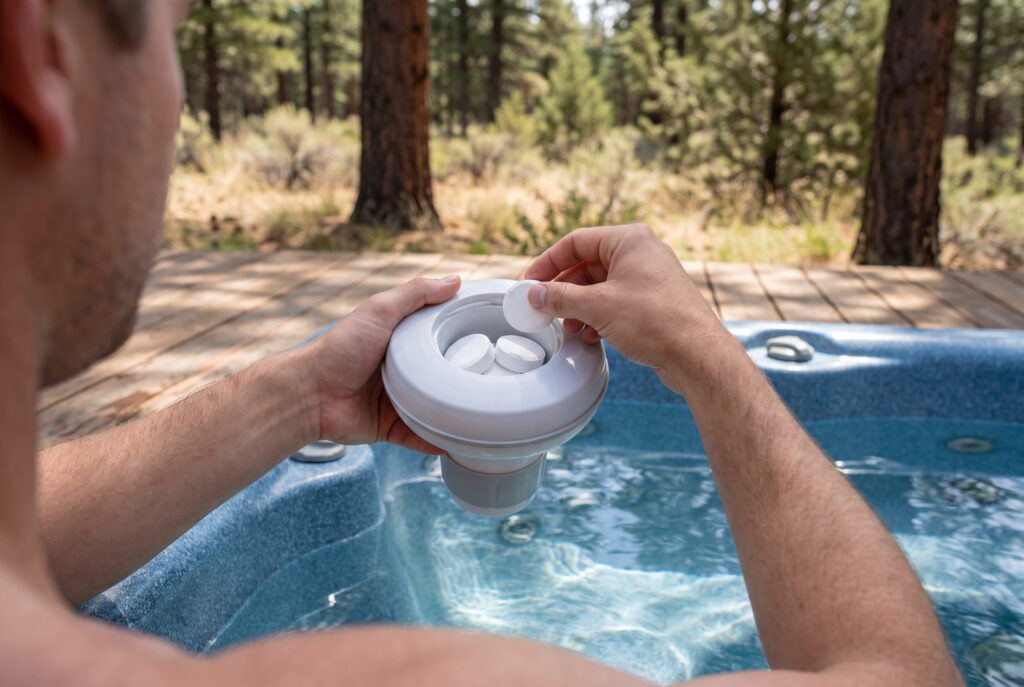
Most Central Oregon homeowners use one of five systems. Ask us for the best hot tub sanitizer for a backyard spa and the answer is usually chlorine, but it is worth knowing what each option does.
| Sanitizer Type | Advantages | Considerations | Best For |
|---|---|---|---|
| Chlorine | Fast-acting, affordable, effective | Stronger odor if poorly maintained | Most residential spas |
| Bromine | Milder odor, tolerates higher pH | Cannot be shielded from UV, costs more, acts slower | Indoor or heavily shaded spas |
| Salt Water Systems | Generates chlorine on demand, fewer manual doses | Higher initial investment | Owners who would rather dose less often |
| Mineral Systems | Reduces chemical demand | Must be paired with a primary sanitizer | Supplemental water care |
| Biguanide Systems | Chlorine-free option | Requires compatible products | Sensitive users |
Salt systems still produce chlorine. They generate it on demand instead of asking you to add it, which reduces handling but adds a cell that needs cleaning and continual replacement. Not all brands of spas allow for salt, so check with the manufacturer.
Before you commit, check how often your spa gets used, how much time you want to spend each week, and what your manufacturer recommends, since some warranties depend on the system you choose. Our team walks through this with every customer looking at hot tubs in our Bend and Sisters showrooms.
Chlorine vs. Bromine: Which Is Better?
For a backyard spa in Central Oregon, our answer is chlorine. Bromine is a legitimate, EPA-registered sanitizer, but it carries one weakness our climate makes worse and several smaller ones that add up over a season.
| Feature | Chlorine | Bromine |
|---|---|---|
| Protection from sunlight | Stabilized with cyanuric acid | No effective stabilizer exists |
| Sanitizing speed | Faster | Slower |
| Cost per season | Lower | Higher |
| Performance above pH 8.0 | Drops off | Holds up better |
| Odor in the water | Sharper when neglected | Milder |
| Odor on skin and swimwear | Rinses off easily | Tends to linger |
| Switching away later | Straightforward | Requires a full drain and refill |
| Our recommendation | Default for most backyard spas | Indoor or heavily shaded spas |
The deciding factor is sunlight. Chlorine can be shielded from UV with cyanuric acid, and stabilized products like dichlor arrive with it blended in. Bromine has no equivalent, so every minute your cover is open during daylight, it burns off with nothing defending it. That matters more here than most places: Bend sits above 3,600 feet with roughly 300 sunny days a year, and UV intensity climbs with elevation.
Cost and speed compound it. Bromine runs more per season, acts more slowly against bacteria, and generally needs to be held higher than chlorine to do the same work. It also locks you in, because bromide ions settle into surfaces and plumbing, so switching back to chlorine later takes a full drain, refill, and line flush.
To be fair, bromine holds up better when pH drifts high, and its byproducts stay active as sanitizers rather than becoming the spent chloramines behind chlorine odor. For an indoor or deeply shaded spa, it is defensible. But if gentler water and less odor are what draw you to it, there is a better route, covered further down in this article.
One misconception pushes people toward bromine for the wrong reason: that sharp chlorine smell is not a sign of too much chlorine. It means the opposite. The odor comes from chloramines, formed when chlorine combines with body oils and sweat. A strong smell almost always means your free chlorine is used up and the water needs shocking.
How Much Hot Tub Sanitizer Should You Use?
Recommended Sanitizer Levels
Your spa manual is the first authority, since ranges vary by model, surface material, and equipment. The widely referenced benchmarks give you a frame of reference.
CDC guidance on home pool and hot tub water treatment recommends pH between 7.0 and 7.8 with free chlorine at 3 ppm or higher. The Pool & Hot Tub Alliance publishes a working range closer to 2 to 4 ppm free chlorine for residential spas, with bromine held around 4 to 6 ppm.
Those are close enough that the takeaway is simple: pick your target range, write it inside your chemical cabinet, and test against it consistently. A level always in range beats one swinging from zero to very high. Test before you soak rather than after, and dose with the jets running so the product disperses.
Factors That Affect Sanitizer Demand
How fast your chemicals get consumed depends on what the water handles:
- Bather load. Four people for an hour uses dramatically more than one person for twenty minutes. This is the biggest variable by far.
- Water temperature. Running at 104 degrees burns through chemicals faster than 98 degrees.
- Lotions, body oils, sunscreen, and hair products. The main culprits behind foam, scum lines, and sudden crashes. A rinse before soaking makes a real difference.
- Sunlight and open-cover time. UV breaks down unstabilized chlorine, so long uncovered afternoon soaks cost more than evening ones.
- Outdoor debris. In Central Oregon, juniper pollen in spring, ponderosa needles year-round, and summer dust.
This is why levels crash after a party. It is not a malfunction, and it is why you test after heavy use rather than assuming yesterday’s reading still applies.
How to Test Your Hot Tub Water
Testing is the whole game. Without it you are guessing, and guessing is how small imbalances become cloudy water.
Test four things: sanitizer level, pH, total alkalinity, and calcium hardness. The first tells you whether the water is protected. pH and alkalinity determine whether that protection can do its job. Calcium hardness guards surfaces against corrosion and scaling.
Test strips are fast, cheap, and right for quick checks several times a week. Keep the container sealed and replace them once they expire, since old strips read unreliably. Liquid kits take longer and cost more but give more precise numbers, which is worth it when something looks off.

Maintaining Proper Water Balance
Spa water chemistry is a system. When one number drifts, the others follow.
| Water Parameter | Typical Target Range | Why It Matters |
|---|---|---|
| Free chlorine | Roughly 2 to 4 ppm | Controls bacteria and maintains protection |
| Bromine | Roughly 4 to 6 ppm | Maintains sanitation at high temperatures |
| pH | 7.2 to 7.8 | Protects equipment and bather comfort |
| Total alkalinity | 80 to 120 ppm | Stabilizes pH and prevents swings |
| Calcium hardness | 150 to 250 ppm | Prevents corrosion and scaling |
Do not combine chlorine and bromine. Defer to your spa manual, since some manufacturers specify tighter windows for particular shell materials.
pH directly affects how well chlorine works. Above 8.0, its ability to kill germs drops sharply, so 3 ppm in high-pH water does far less than 3 ppm in balanced water. Owners chasing a stubborn problem with more and more chlorine are often solving the wrong variable.
Alkalinity is the stabilizer behind pH. When it sits low, pH bounces after every adjustment. Correct alkalinity first, then pH, then your sanitizer. Our guide to lowering alkalinity in a hot tub covers that step in detail.
Common Hot Tub Sanitizer Mistakes
After years of troubleshooting water, we see the same issues repeatedly.
| Mistake | Result | Better Practice |
|---|---|---|
| Dosing only occasionally | Bacteria growth and odor | Maintain consistent levels |
| Ignoring water testing | Chemical imbalance | Test on a regular schedule |
| Mixing incompatible chemicals | Equipment damage and dangerous reactions | Follow manufacturer guidance and add one product at a time |
| Overdosing | Skin and eye irritation | Add small amounts and test before adding more |
| Neglecting filter maintenance | Reduced water quality and strained equipment | Clean filters routinely |
Almost every one of these is a habit problem, not an equipment problem. The fix is simple: pick one day a week as your water care day and test, adjust, shock, and rinse your filter on the same day every time. Ten minutes on a Sunday prevents nearly every issue on this list.
Beyond Sanitizer: Other Chemicals Your Hot Tub Needs
Your sanitizer is the star, but it needs a supporting cast:
- Shock treatments oxidize organic waste. Chlorine shock also raises chlorine levels; non-chlorine shock clears organics without doing so, useful when you want to soak sooner.
- pH increaser and decreaser move acidity into your target window.
- Alkalinity increaser stops pH swinging after every adjustment.
- Calcium hardness increaser protects surfaces when your source water is soft.
- Clarifiers, defoamer, and filter cleaner handle appearance and keep filtration at full capacity.
- Water conditioners and enzyme treatments break down organic material and biofilm so your chlorine does not have to.
All of these support your sanitizer. None replaces it. Our team carries and explains a full range of hot tub chemicals for every system we sell.
Pairing Chlorine With Spa Marvel and AquaFinesse
This is the setup we recommend more than any other. Chlorine does the sanitizing, and a conditioner handles the organic material that makes chlorine work harder than it needs to.
AquaFinesse targets biofilm, the bacterial layer inside jets and plumbing that no brush can reach. Biofilm quietly consumes sanitizer, so clearing it lowers what your water demands week to week. Our AquaFinesse water care page explains how the system works. Spa Marvel is an enzyme-based conditioner that breaks down body oils, lotions, and sweat before your chlorine has to, and it changes how the water feels. Owners with dry or sensitive skin usually notice first.
Run either alongside chlorine and the result is the same: you add less product over a season, the water feels softer, and the sharp chemical smell of spent chlorine largely disappears. That last point matters, because odor is the most common reason owners consider bromine.
One thing to be clear about. Neither product replaces your sanitizer, and neither lowers the level you should be holding. Your target range stays exactly where it was. What changes is how much chlorine you add to stay there, because less organic material is burning through it.
Hot Tub Water Care Maintenance Schedule
Print this, tape it inside your equipment door, and you have solved most of hot tub ownership.
| Maintenance Task | Recommended Frequency |
|---|---|
| Test sanitizer levels | Before each use, or several times per week |
| Check pH and alkalinity | Weekly |
| Shock the water | Weekly, or after heavy use |
| Clean filters | Every 2 to 4 weeks |
| Drain and refill water | Every 4 to 6 months |
| Inspect equipment and cover | Monthly |
A spa on this schedule rarely clouds, smells, or surprises you. One maintained sporadically eventually demands a full drain and a much longer afternoon than the ten minutes a week you skipped. If you soak heavily through winter, expect to shock and test more often than your summer routine calls for.
When to Seek Professional Water Care Advice
Some problems are worth a phone call rather than another trip to the chemical shelf. Reach out when you notice:
- Cloudy water that returns within a day or two of correcting it
- Recurring bacteria, algae, or slime despite consistent levels
- A strong chemical odor that shocking does not resolve
- Readings that will not hold, dropping to zero within hours of dosing
- Equipment concerns, including heater issues, weak jets, or unusual noise
Persistent symptoms usually point behind the panel rather than into the water: biofilm in the plumbing, a filter past its life, a failing component, or source water with unusual mineral content. When the issue turns out to be mechanical, our technicians handle hot tub repair across Bend, Sisters, Redmond, Sunriver, and the surrounding communities.

Why Homeowners Trust Aqua Clear for Water Care
Aqua Clear has spent years helping Central Oregon homeowners move from reactive troubleshooting to a routine that works. We know how local fill water behaves and how our dry high-desert climate affects chemical demand.
Bring a sample to the showroom on Robal Lane in Bend or Hood Avenue in Sisters and we will test it while you wait, then send you home with the right products rather than a cart full of guesses. Aqua Clear Hot Tubs also offers Professional hot tub service and maintenance support and recurring hot tub service plans for owners who would rather hand the routine off entirely.
Conclusion
Proper sanitizing is the foundation of clean, healthy hot tub ownership. Everything else in your routine exists to help it work.
Test regularly, hold your levels where your manufacturer recommends, balance pH and alkalinity, and stay on a weekly schedule. Do those four things and your spa will be ready whenever you want it. When the water refuses to cooperate, reach out to Aqua Clear rather than guessing for weeks. A five-minute test at the shop often solves what has frustrated someone for a month.
FAQs
Can I switch from chlorine to bromine in my existing hot tub?
You can, though we are usually asked the reverse, and we would steer you toward staying with chlorine. Either direction takes a full drain and refill rather than a product swap: drain, clean the shell, flush the plumbing lines, fit a clean filter, then refill and set your level. Note that bromide ions persist in water and plumbing, so switching back later means repeating the whole process.
Why does my hot tub still smell strongly even when sanitizer levels are correct?
That smell is chloramines, the spent compounds formed when chlorine binds with body oils, sweat, and lotions. Your strip may show a reasonable total while your free chlorine, the part doing the work, is gone. Shock the water to break those bonds. If the odor returns after shocking, suspect biofilm in the plumbing or a filter due for replacement.
Is it safe to use a hot tub immediately after adding sanitizer?
No. Wait until the product has dissolved, circulated, and settled back into range. Run the jets with the cover open for 15 to 20 minutes, then test before soaking. Elevated chemical levels irritate skin and eyes. Follow the wait time printed on the label, since it varies by product and concentration.
How does heavy hot tub use affect sanitizer levels?
Significantly. Every bather introduces organic material that consumes chemicals, making bather load the biggest driver of demand. After a party or a weekend with guests, expect levels to drop sharply and plan to test and shock afterward rather than waiting for your weekly check. Rinsing off beforehand and keeping the cover on between soaks both slow the burn rate.
Can well water or hard water change how my hot tub sanitizer performs?
Yes. Many homes outside Bend and Sisters fill from wells, and that water can carry iron, manganese, or high calcium. Calcium scales heaters and jets, while metals stain and discolor once chemicals go in. Test your fill water before it enters the spa, use a pre-filter on the hose if your source runs mineral-heavy, and add a sequestrant when needed.