
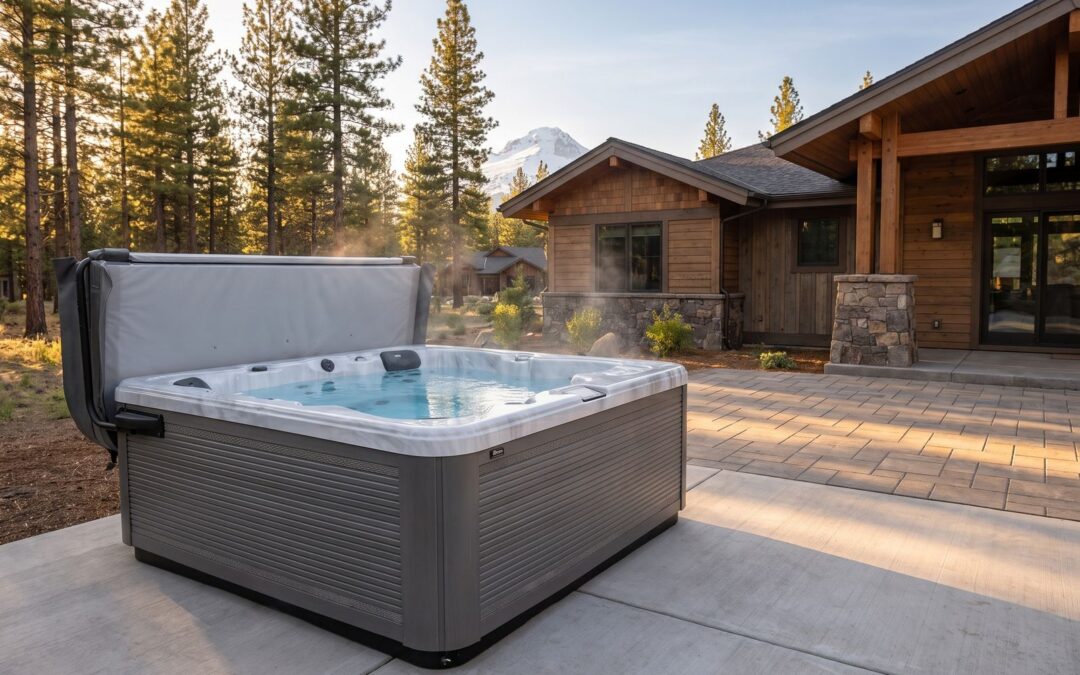
Hot Tub Sizes Explained: How to Choose the Perfect Fit for Your Space
Picture this: you’ve finally picked out the perfect spot on your patio, you can already imagine soaking under the stars after a day on Mt. Bachelor, and then you realize the spa you love won’t fit through the side gate. It happens more often than you’d think.
Choosing between hot tub sizes involves a lot more than counting seats. You need to think about the spa’s actual dimensions, the space around it, how it will get delivered, what the foundation can support, and how you’ll really use it day to day. A larger spa offers more room and more features, but it needs more space. A compact model may tuck neatly into a small patio, but it can limit seating and legroom.
This hot tub size guide walks you through the common size categories, what to measure, and the mistakes to avoid, so you can find the right fit for your household and your property before you buy.
Key Takeaways
- Hot tubs generally fall into three size groups: small (2–3 people), medium (4–5 people), and large (6–7+ people), but exact dimensions vary by manufacturer and model.
- Seat count isn’t the whole story. Lounge seats, corner seats, and footwell space change how many people can comfortably soak at once.
- Measure more than the spa. Plan for clearance around the tub, cover operation, service access, and the full delivery route.
- Bigger isn’t automatically better. Choose based on how many people will use the spa regularly, not the maximum you can fit.
- Decks and unusual sites need a professional look. A filled spa can weigh several thousand pounds, so structural, electrical, and access questions should be answered before you order.
- A site assessment is a pre-purchase tool, not just an installation formality. It helps you choose the right size the first time.
What Hot Tub Sizes Are Available?
Most hot tubs fit into three broad categories: small, medium, and large. Within each category, though, every manufacturer has its own shell designs, seating layouts, and dimensions. Two “five-person” spas from different brands (or even different series from the same brand) can feel very different once you sit inside.
That’s because advertised capacity often counts every possible seating position, including lounge seats, corner seats, and spots that only work if everyone tucks their legs. When comparing models, look at the actual seating layout rather than relying on the number printed on the spec sheet.
Here’s a quick overview to get you started:
| Hot Tub Size | Typical Capacity | Best For | Space Consideration |
|---|---|---|---|
| Small | 2–3 people | Couples, smaller patios, limited spaces | Minimal footprint |
| Medium | 4–5 people | Couples, families, entertaining | Moderate footprint |
| Large | 6–7+ people | Families and frequent entertaining | Requires substantial space |
Standard Hot Tub Dimensions at a Glance
There’s no single industry standard, but many spas land within these general ranges. Use them as a starting point for planning, then confirm the exact specifications for any model you’re considering.
| Size Category | Approximate Length & Width | Approximate Water Capacity |
|---|---|---|
| Small (2–3 person) | About 5.5–7 feet (66–84 inches) | Roughly 150–300 gallons |
| Medium (4–5 person) | About 7 feet (around 84 inches) | Roughly 300–400 gallons |
| Large (6–7+ person) | About 7.5–8+ feet (90–100+ inches) | Roughly 400–500+ gallons |
Most hot tubs stand roughly 30–40 inches tall. Dimensions above are general ranges, not manufacturer specifications. Always verify the exact measurements of the specific model you plan to buy.
Hot Tub Sizes and Dimensions: What You Actually Need to Measure
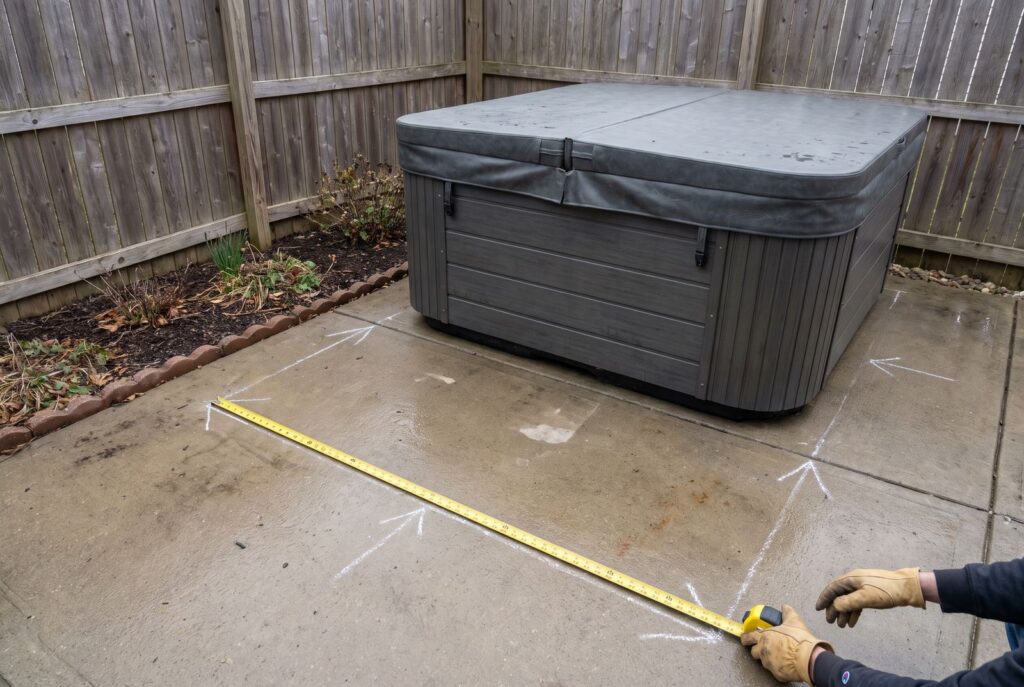
A hot tub’s listed dimensions tell you how much space the cabinet takes up. They don’t tell you how much space the spa needs to be installed, used, opened, and serviced. That total footprint is almost always larger than the spa itself.
Before you start shopping, grab a tape measure and work through this checklist:
- Available length and width of the intended location
- Height restrictions, such as eaves, pergolas, windows, or covered patios
- The access path from the driveway or street to the final spot
- Foundation dimensions, whether it’s an existing slab, a new pad, or a deck
- Electrical location and the distance to your main panel
- Surrounding clearance for entry, the cover, and equipment access
Measure the actual installation area rather than assuming a spa will fit because the numbers look close. A few inches can be the difference between an easy install and a frustrating redesign.
Don’t Forget the Space Around the Hot Tub
You’ll need room to step in and out comfortably, open and fold back the cover, clean around the cabinet, and reach the equipment panel when it’s time for service. Recommendations vary by model, and Angi’s hot tub size guide suggests planning for roughly 12 to 36 inches of clearance on each side of the spa.
Walls, fences, landscaping, railings, stairs, and patio furniture can all turn a spot that looks perfect on paper into one that’s impractical in real life. Here in Central Oregon, it’s also worth thinking about where snow will slide off a roof and how you’ll keep a path to the spa clear in January.
Confirm clearance requirements with the manufacturer and your installer before you finalize the location. At Aqua Clear, we take the guesswork out of this step with a pre-delivery site assessment. One of our specialists visits your property to confirm the measurements of your installation area, check clearance for the cover and equipment access, and walk the delivery route from the driveway to the final spot. That way, you know the spa you’ve chosen will fit your space before it ever leaves our showroom.
Small Hot Tubs: When a Compact Model Makes Sense
Small hot tubs are a great fit for couples, individuals, and homeowners with smaller patios or decks. If your main goal is a quiet evening soak for one or two people, a compact spa can deliver relaxation and hydrotherapy without taking over your backyard.
A smaller footprint usually means easier placement and more flexibility on where the spa can go. It may also simplify delivery, especially for homes with narrow side yards or tight gates, which are common in many Bend neighborhoods.
The trade-offs are real, though. Compact models typically offer fewer seating options, less legroom, fewer jets, and less room for guests. If you entertain often, a small spa can feel crowded quickly.
Pros and Cons of Small Hot Tubs
| Advantages | Potential Limitations |
|---|---|
| Fits smaller outdoor spaces | Fewer seating options |
| Easier to incorporate into compact patios | Less room for multiple users |
| Can suit couples or individual users | May have fewer features |
| More flexible placement options | Less suitable for frequent entertaining |
Medium Hot Tubs: The Versatile Choice for Most Homeowners
Medium spas are the practical middle ground. They give you multiple seating options and room for a few guests without committing to the footprint of a large model. For many households, a 4–5-person spa is the most popular hot tub size because it balances everyday comfort with flexibility.
What to Look for in a Medium-Sized Spa
- Lounge vs. upright seating: A lounge seat is wonderful for one person but takes up space that could hold two upright seats.
- Jet placement: Make sure the seats you’ll use most target the areas you care about, like your back, neck, or feet.
- Footwell space: A roomy footwell lets several adults stretch out without bumping legs.
- Entry and exit: Check where the steps are and whether the entry seat is comfortable to climb into.
- Simultaneous comfort: Ask whether everyone can sit comfortably at the same time, not just one at a time.
Whenever possible, test the seating in person. Photos can’t tell you how deep a seat feels or whether your knees touch your partner’s.
Large Hot Tubs: When Bigger Really Is Better
A large spa makes sense for bigger families, frequent entertainers, and households where several adults regularly soak together. If you love hosting, or you want plenty of room to stretch out, a larger model can be worth the extra space.
Large spas require more than a larger patio, though. You’ll need to account for delivery access, a bigger foundation, room to move the cover, and service access around the cabinet. They also take more water to fill, more energy to heat, and slightly more chemical attention to keep balanced.
Is a Large Hot Tub Worth the Extra Space?
Start by asking how often you’ll actually use every seat. Consider two homeowners:
- The entertainer hosts friends most weekends and has teenagers who bring guests home. A 6–7-person spa gets used to its full capacity regularly.
- The couple soaks together most evenings and has guests a few times a year. A large spa would mostly sit with empty seats they’re paying to heat.
How to Choose the Right Hot Tub Size for Your Household
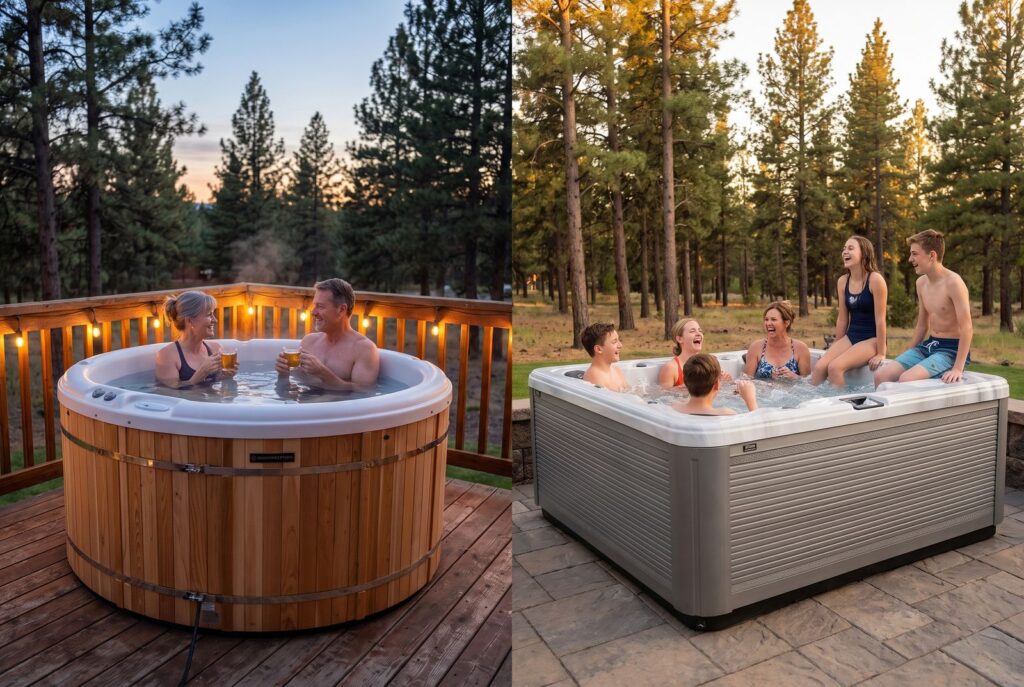
A simple way to narrow your options is to consider five factors: the number of regular users, how often you have occasional guests, your available space, the intended location, and the features you want.
The number of people in your household doesn’t automatically equal the right capacity. A family of four where only two people soak regularly may be happiest in a smaller spa, while a couple who loves hosting may want a medium or large model.
| Your Situation | Size Direction to Consider |
|---|---|
| One or two regular users | Small/compact |
| Couple with occasional guests | Small to medium |
| Family of four | Medium |
| Family plus frequent guests | Medium to large |
| Frequent entertaining | Large |
| Limited patio/deck space | Compact model |
If you’re torn between sizes, browse our hot tub models to compare layouts side by side.
Indoor vs. Outdoor Space: Where Size Matters Most
Where you put your spa affects which sizes are realistic. A concrete slab, a paver patio, a wood deck, a covered porch, and an indoor room all come with different considerations. A hot tub’s footprint has to be evaluated alongside the structural and environmental characteristics of the location.
Covered areas need enough overhead clearance for the cover to open fully and good ventilation for humidity. Indoor installations add drainage and moisture control to the list. Outdoor spots in Central Oregon should account for snow load, sun exposure, and wind.
Decks deserve special care. A filled spa can weigh several thousand pounds once you add water and people, and many standard decks aren’t built to carry that kind of concentrated load. As Family Handyman explains, an existing deck may need reinforcement, such as stronger joists or added footings, before it can safely support a hot tub. Have a qualified professional evaluate the deck’s structural capacity rather than assuming it can handle the load.
- Measure the available footprint, including length, width, and any overhead limits.
- Identify fixed obstacles like posts, railings, stairs, downspouts, and windows.
- Map the access route from where the delivery vehicle will park.
- Add required clearance for entry, the cover, and the equipment side.
Be sure the plan includes space for the cover to fold back (and a cover lifter, if you’ll use one) plus room for service. If the location has unusual access, structural, electrical, or placement constraints, a professional site assessment is the best way to avoid surprises. We include a free site assessment with every purchase.
Hot Tub Delivery and Access: Will It Actually Fit?
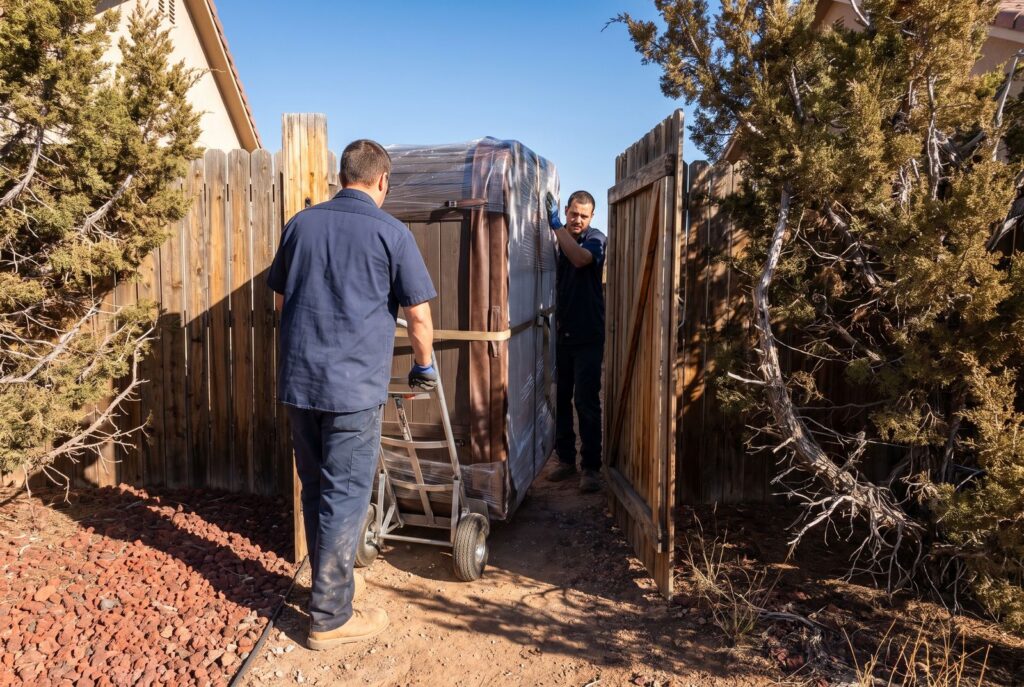
One of the most overlooked parts of hot tub sizing is getting the spa from the truck to its final spot. Gates, fences, narrow side yards, landscaping, stairs, doorways, overhead branches, and tight turns can all stand in the way.
Spas are often moved on their side using a dolly or cart, and larger installs sometimes require a crane. That’s why the delivery route should be evaluated before you purchase, not after the spa has already been ordered.
What to Measure Before Ordering
- Gate widths and any removable fence panels
- Pathway widths, including along the side of the house
- Turning areas at corners and around obstacles
- Stairways, steps, and slopes
- Overhead clearance from eaves, trees, and wires
- The final installation location itself
Spa dimensions alone don’t determine whether delivery is possible, because transport equipment and maneuvering space matter too. Our team can review the full route during a site assessment and flag potential problems early. You can also learn more about the full process in our step-by-step installation guide.
Hot Tub Size vs. Features: Don’t Sacrifice What You Want
Larger spas often have room for more seating, more jets, water features, lighting, and entertainment systems. But more isn’t always better. Prioritize the features you’ll actually use and balance them against footprint, seating, ergonomics, and budget.
Before narrowing down models, make a short list of your “must-haves.” For some buyers, that’s a deep therapy seat for a sore back. For others, it’s a neck therapy station to relieve their shoulders and neck. Size should support those priorities, not replace them.
Lounge Seats vs. Open Seating
A full-length lounge seat can be the most relaxing spot in the spa, but it changes the effective capacity. A spa with a lounger may comfortably seat one fewer adult than an open-seating design of the same size.
That’s why two models marketed for the same number of people can feel completely different inside. Sit in each one if you can, and try the seats you’d actually use.
Common Hot Tub Sizing Mistakes to Avoid
- Measuring only the spa footprint: Clearance and access matter just as much as the cabinet dimensions.
- Choosing based only on seat count: Seat configuration determines real-world comfort far more than the number on the brochure.
- Forgetting the cover: You need room to open, fold back, and store the cover, especially with a lifter attached.
- Ignoring delivery access: Measure the entire route before you buy, not just the destination.
- Choosing the biggest model available: Buy for how you’ll actually use the spa, not the maximum it could hold.
- Installing without professional assessment: Electrical, foundation, placement, and access requirements should be checked in advance.
How a Site Assessment Helps You Choose the Right Size
A professional site assessment looks at the whole picture: available space, access, foundation, electrical requirements, placement, and potential installation obstacles. It’s one of the best ways to narrow down the right size before you commit.
Think of it as a pre-purchase planning tool, not an installation formality. Knowing exactly what your property can accommodate lets you shop confidently and avoid costly changes later.
Electrical is a good example. Some compact spas run on a standard 120V plug-in connection, while most full-size models need a dedicated 240V circuit. 240V spas typically heat faster and can run the heater and jets at the same time, which makes a noticeable difference during cold Central Oregon winters. Your assessment will clarify what’s needed. Because water and electricity don’t mix, the Electrical Safety Foundation International recommends having a qualified electrician handle hot tub wiring in line with local codes and the National Electrical Code.
Why Central Oregon Homeowners Choose Aqua Clear Hot Tubs
At Aqua Clear Hot Tubs, we help homeowners from Bend to Sisters, Redmond, Sunriver, and Black Butte find spas that fit both their lifestyle and their property. Our hot tub specialists look at the complete purchase, from sizing and seating to delivery, foundation, and electrical, so there are no surprises on installation day.
Visit our Bend or Sisters showroom to sit in different models and compare layouts in person. After installation, we’re here for the long haul with service, water care, and practical hot tub maintenance guidance.
A Step-by-Step Hot Tub Size Buying Checklist
Before you visit a dealer or choose a model, run through this list:
- Measure the intended location.
- Measure the delivery route.
- Determine regular and occasional users.
- Identify seating and feature priorities.
- Account for cover and service access.
- Confirm foundation and electrical requirements.
- Schedule a professional site assessment if needed.
Tip: Bring your measurements and a few photos of the installation area when you talk with a hot tub specialist. It makes the conversation faster and the recommendations more accurate. And always confirm final dimensions, clearances, and installation requirements for the specific model you’re buying.
Conclusion
The best hot tub size isn’t necessarily the largest or the smallest. It’s the one that fits both your lifestyle and your property. Weigh your household size, how you’ll use the spa, the physical footprint, delivery access, surrounding clearance, seating configuration, and installation requirements, and the right choice usually becomes clear.
If you’re ready to explore your options, the team at Aqua Clear Hot Tubs is happy to help. Stop by our showroom, talk with one of our specialists, or schedule a site assessment before you buy, so the spa you choose fits your space and the experience you’re looking for.
FAQs
Can a hot tub be installed on a deck?
Yes, many hot tubs are installed on decks, but the deck must be able to support the full weight of a filled spa plus people, which can easily reach several thousand pounds. Have a qualified contractor or structural engineer evaluate the deck before purchasing.
How much clearance should I leave around a hot tub?
Plan for enough room to get in and out comfortably, open the cover, and reach the equipment panel. Many manufacturers recommend about 18–24 inches of access on the equipment side, but requirements vary by model, so confirm with the manufacturer and your installer.
Can a hot tub be smaller than the number of people who will use it?
Yes. Size your spa for the people who will use it regularly, not for every person in your household or every guest who might visit. If only two people soak most nights, a smaller spa can be more practical and efficient.
What is the smallest hot tub size available?
The smallest hot tubs are typically 2–3-person models, often around 5.5–6.5 feet across. Some compact spas run on standard 120V power. Exact dimensions vary by manufacturer, so check the specifications for any model you’re considering.
Can I move a hot tub after it has been installed?
Yes, but it takes planning. The spa must be drained, disconnected from power, and moved with the right equipment, and the new location needs a proper foundation and electrical setup. It’s usually best to choose the right size and location from the start.