
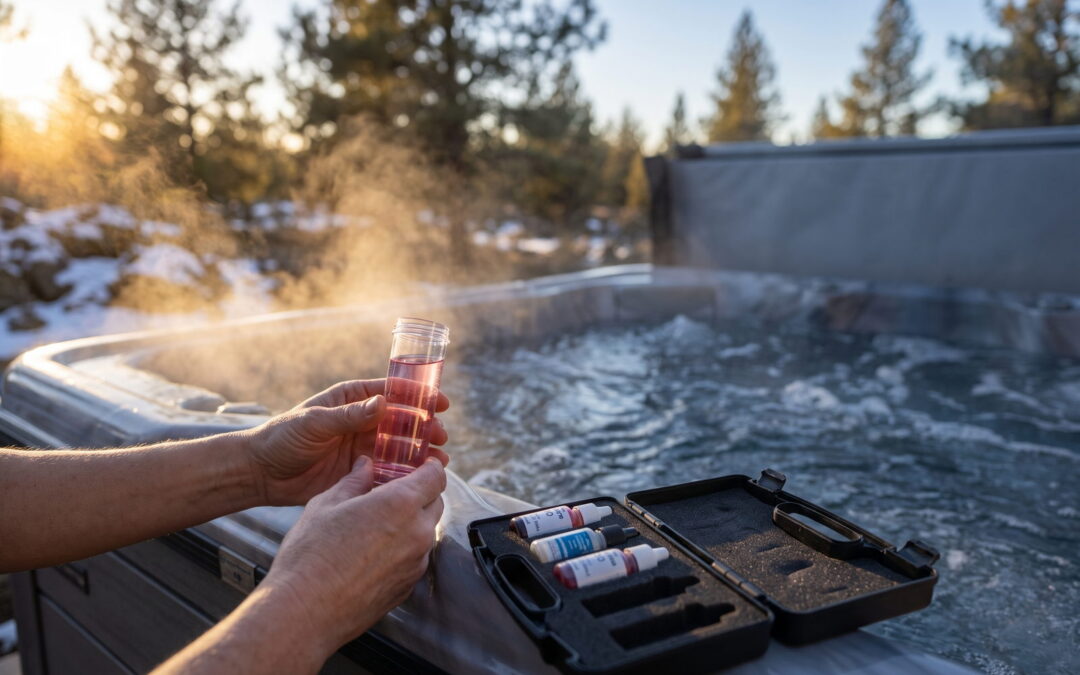
Few things end a soak faster than cloudy water, itchy skin, or that sharp chemical smell drifting off the surface. In almost every case, the problem traces back to the same root cause: water chemistry that quietly drifted out of range before anyone noticed.
That’s where testing comes in, and where most spa owners hit their first real decision. Do you invest in a hot tub test kit with liquid reagents, or keep a bottle of test strips on the shelf and dip one in every few days?
Here’s the honest answer: both methods work, and both are used by professionals every day. The right choice depends on your experience level, how often you soak, and how much detail you actually want from your readings. Below, we compare accuracy, cost, ease of use, and real-world reliability so you can pick the method you’ll actually stick with.
Key Takeaways
- A hot tub test kit uses liquid reagents for precise, numeric readings. Test strips trade a little precision for speed and simplicity.
- Both methods measure the same core parameters: sanitizer, pH, total alkalinity, and calcium hardness.
- Test strips are ideal for quick checks several times a week. A liquid kit is better when you’re correcting an imbalance or need very precise numbers.
- User error (expired strips, damp storage, careless sampling) causes more bad readings than the testing method itself.
- Many experienced owners use both: strips for routine monitoring, a liquid kit for detailed balancing.
- The best method is the one you’ll use consistently. Consistency beats precision every time.
Why Water Testing Is Essential for Every Hot Tub
Hot tub water sits between 100°F and 104°F: warm, wet, and aerated by the jets. Those are close to ideal conditions for bacteria. Your sanitizer is the only thing standing in the way, and testing is the only way to know whether it’s actually doing its job.
pH matters just as much as sanitizer level. According to the CDC’s guidance on home hot tub water treatment, chlorine’s ability to kill germs drops as pH rises, especially above 8.0. In other words, you can have plenty of chlorine in the water and still be soaking in water that isn’t properly sanitized.
Under-sanitized water isn’t just unpleasant, either. Hot tub folliculitis, the itchy red rash caused by Pseudomonas aeruginosa, is a well-documented result of soaking in a poorly maintained spa.
Testing protects your equipment, too. Water that’s too soft or too acidic pulls minerals out of heater elements and seals. Water that’s too hard or too alkaline leaves scale on jets, sensors, and plumbing. That’s the kind of buildup that eventually becomes a service call.
The most important mindset shift: hot tub water testing is preventive maintenance, not troubleshooting. By the time water turns cloudy or starts to smell, the imbalance has usually been building for a week or longer.
What Does a Hot Tub Test Measure?
Every hot tub water testing method (strips, liquid kits, or a professional in-store test) is looking at the same handful of numbers.
| Water Parameter | Why It Matters | Impact if Out of Balance |
|---|---|---|
| Sanitizer (chlorine/bromine) | Kills bacteria and contaminants | Unsafe water, bacteria growth |
| pH | Water comfort and sanitizer efficiency | Skin irritation, ineffective sanitizer |
| Total alkalinity | Stabilizes pH | Frequent pH fluctuations |
| Calcium hardness | Protects equipment and surfaces | Scaling or corrosion |
| Cyanuric acid (if applicable) | Stabilizes chlorine in certain systems | Reduced sanitizer performance |
In plain terms: sanitizer does the cleaning, pH decides how well it works, alkalinity keeps pH from bouncing around, and calcium hardness protects your shell, heater, and seals. Here are the ranges most spa manufacturers target:
- Free chlorine: 3–5 ppm (the CDC recommends at least 3 ppm in hot tubs)
- Bromine: 3–5 ppm
- pH: 7.4–7.6
- Total alkalinity: 80–120 ppm
- Calcium hardness: 150–250 ppm
These values don’t work independently. Raise alkalinity and pH usually follows. Add a heavy dose of shock and pH can dip temporarily. That’s why a full hot tub water chemistry reading is far more useful than checking one number in isolation.
What Is a Hot Tub Test Kit?
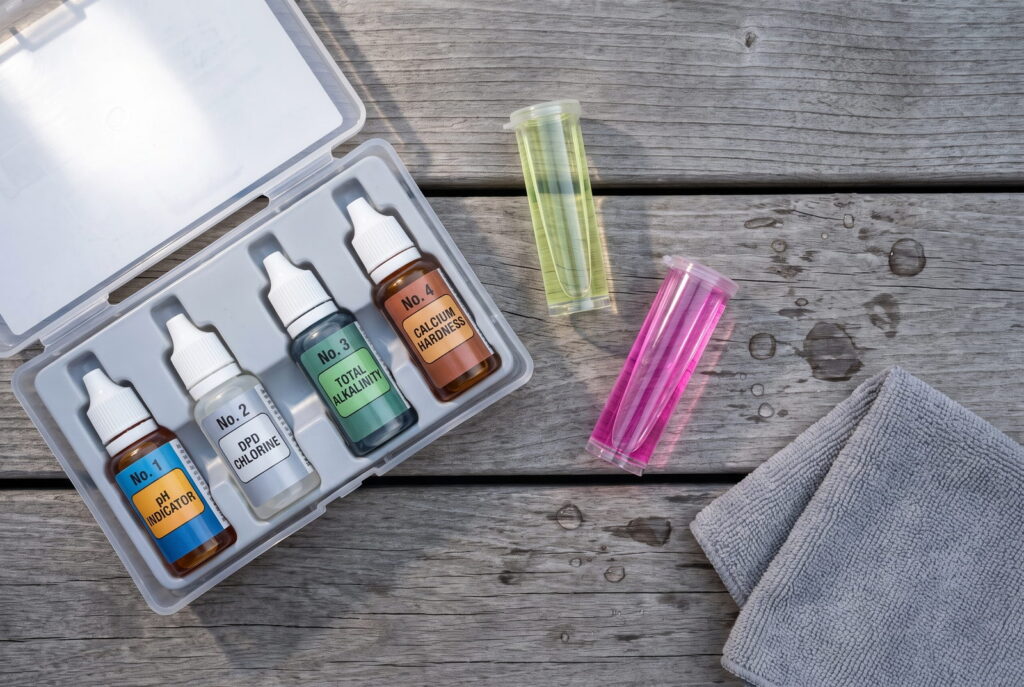
A hot tub test kit, also sold as a spa water test kit or DPD kit, measures water chemistry by adding measured drops of liquid reagent to a sample of spa water. There are two ways these kits produce a reading:
- Colorimetric: You add a set number of drops, the sample changes color, and you match that color against a printed comparator block. This is how most kits read chlorine, bromine, and pH.
- Titration: You add drops one at a time and count how many it takes for the sample to change color. Each drop equals a set value, which is the standard method for total alkalinity and calcium hardness.
Because you’re reading an actual chemical reaction rather than a printed color band, a liquid test kit hot tub owners rely on gives finer resolution. Instead of “somewhere in the 80 to 120 range,” you get a specific number you can calculate a dose from.
The CDC specifically recommends DPD kits for the most accurate chlorine and pH results at home, which is why experienced owners and service techs tend to keep one on hand. The trade-offs are real, though. A full test takes two to four minutes, reagents expire (usually within a year of opening), and there are simply more steps to get wrong.
What Are Hot Tub Test Strips?
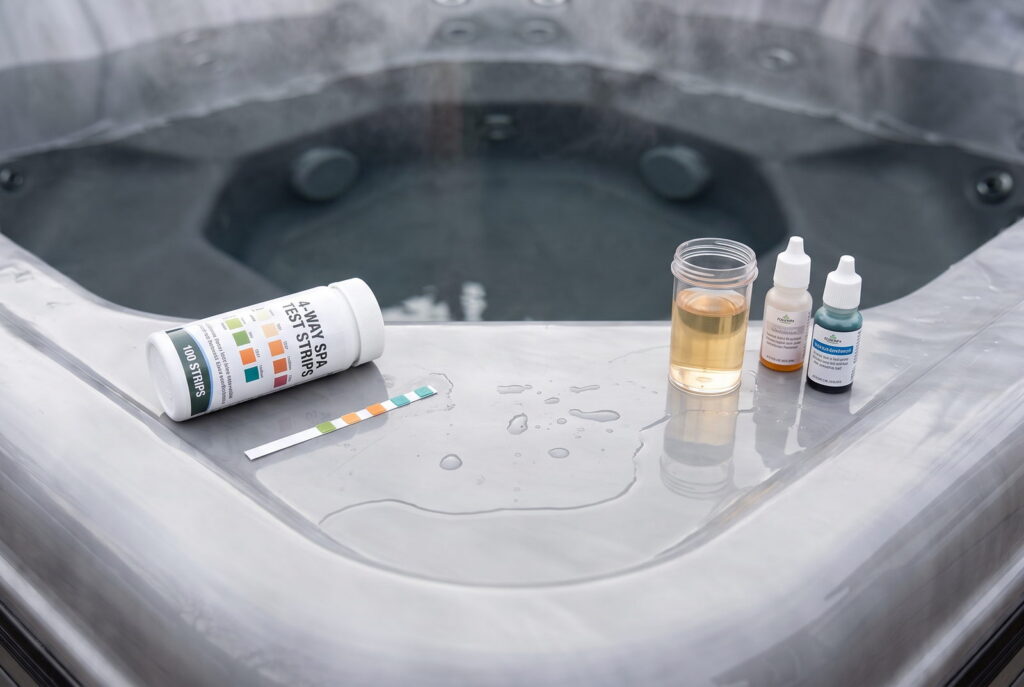
Test strips are the fastest hot tub water testing method available. Dip a strip in the water, hold it still for a few seconds, then compare the colored pads to the chart on the bottle. Start to finish: about 15 seconds.
Most spa strips read four to seven parameters at once: typically free chlorine or bromine, pH, total alkalinity, and total hardness, with some adding total chlorine and cyanuric acid.
That convenience is exactly why strips get used more often. A test that takes 15 seconds actually gets done on a cold Tuesday night in January. A test that takes four minutes frequently doesn’t.
The catch is that strip accuracy depends almost entirely on how they’re handled. The reagent pads are moisture-sensitive, so an open bottle sitting in a damp equipment bay, or an unheated garage through a Central Oregon winter, can give unreliable readings long before the printed expiration date.
Hot Tub Test Kit vs Test Strips
Here’s how the two hot tub water testing methods compare side by side:
| Feature | Hot Tub Test Kit | Test Strips |
|---|---|---|
| Accuracy | Higher precision | Good for routine testing |
| Ease of use | Moderate | Very easy |
| Testing speed | Slower (2 to 4 minutes) | Very fast (about 15 seconds) |
| Cost | Higher initial investment | Lower upfront cost |
| Learning curve | Moderate | Beginner-friendly |
| Best for | Detailed water balancing | Routine maintenance |
Neither column is the “right” answer for everyone. A test strip used correctly every three days will keep your water healthier than a precision kit that sits unopened in a drawer.
Accuracy Comparison: Which Testing Method Is More Reliable?
In practice, a fresh, properly stored strip usually lands within one color block of a liquid kit reading. That’s plenty to answer “is my water in range?” It’s less helpful when you need to answer “exactly how much alkalinity increaser should I add?”
Precision matters most in these situations:
- After a drain and refill, when you’re balancing from scratch
- When correcting an imbalance and you need to measure what your last dose actually changed
- When cloudy water keeps returning but strips say everything looks fine
- On well water, common around Bend, Sisters, and Redmond, where calcium hardness often starts high
- After heavy bather loads, like a full tub of friends after a day at Mt. Bachelor
For routine weekly monitoring on a residential spa with stable water, strips are accurate enough. Swim University’s guide to hot tub water testing lands in a similar place: strips for quick checks, liquid reagents when the numbers really matter.
Which Option Is Better for Beginners?
| User Type | Recommended Testing Method | Reason |
|---|---|---|
| First-time hot tub owner | Test strips | Simple and quick |
| Experienced owner | Test kit | Greater accuracy |
| Frequent hot tub user | Combination of both | Convenience and precision |
| Commercial spa operator | Test kit | Detailed water management |
If you’re brand new to spa ownership, start with strips. They remove the biggest barrier to good water care, which is friction. Once testing becomes a habit, usually within a couple of months, adding a hot tub test kit for weekly deep checks is a natural next step.
Whatever you choose, choose what you’ll actually use. Consistency matters far more than complexity. A beginner testing reasonably well twice a week will have better water than an expert testing perfectly once a month.
Common Water Testing Mistakes
User error causes more inaccurate readings than any testing method ever will. These are the mistakes we see most often:
| Mistake | Potential Problem | Better Practice |
|---|---|---|
| Using expired test strips | Inaccurate readings | Note the open date and replace regularly |
| Improper strip storage | Moisture damage to reagent pads | Keep the container sealed and indoors |
| Incorrect sample collection | Misleading results | Follow instructions carefully |
| Skipping routine testing | Water imbalance | Test on a consistent schedule |
| Ignoring recommended ranges | Poor water quality | Adjust chemicals promptly |
A few habits that make any test more reliable:
- Run the jets or circulation pump for 15 to 20 minutes before testing so the water is fully mixed
- Collect your sample elbow-deep, away from jets, returns, and the skimmer
- Don’t shake water off a strip. Hold it still and read within the time window on the bottle
- Read colors in natural daylight rather than under a porch light
- Wait at least 20 to 30 minutes after adding a chemical before retesting
How Often Should You Test Your Hot Tub Water?
| Maintenance Task | Recommended Frequency |
|---|---|
| Check sanitizer | Before each use, or several times weekly |
| Test pH and alkalinity | Weekly |
| Full water chemistry test | Weekly |
| Shock treatment | Weekly, or after heavy use |
| Drain and refill | Every 4-6 months (or as your manufacturer recommends) |
Testing frequency scales with use. A couple soaking twice a week needs less monitoring than a family of five using the spa nightly.
Central Oregon adds a few wrinkles. Our dry high-desert air drives evaporation, which concentrates minerals and can push hardness and alkalinity upward between refills. Summer smoke and pine debris add organic load. And a tub full of friends after a powder day at Mt. Bachelor will burn through sanitizer far faster than a week of quiet evening soaks.
Test again after parties, after heavy rain or snowmelt on an open tub, and any time you top off with fresh water.
Beyond Testing: Maintaining Balanced Hot Tub Water
Testing tells you what’s wrong. Adjusting fixes it, and the order you adjust in matters more than most owners realize.
- Total alkalinity first. It buffers pH, so balancing it makes everything else hold steady.
- Then pH, using increaser or decreaser in small doses, retesting between each one.
- Then calcium hardness, which usually only needs real attention on a fresh fill.
- Then sanitizer, once the water is balanced enough for it to work efficiently.
- Shock weekly or after heavy use to clear chloramines and organic waste.
Filters matter as much as chemistry. Rinse cartridges every two to four weeks, deep-clean them with a filter cleaner every three months, and replace them roughly once a year. A clogged filter will make perfectly balanced water look cloudy anyway.
It also helps to have the right products on hand before you need them. Aqua Clear stocks a full range of hot tub water care products, including sanitizers, balancers, shock, filter cleaners, and gentler systems like AquaFinesse and O-Care for owners who want a simpler routine.
Which Option Offers the Best Value?
Price tags don’t tell the whole story. Test strips typically run $15 to $25 for a bottle of 50 to 100, while a quality spa water test kit runs $30 to $70 up front with reagent refills at $10 to $20.
| Consideration | Test Kit | Test Strips |
|---|---|---|
| Initial cost | Higher | Lower |
| Cost per test | Lower over time | Slightly higher over time |
| Convenience | Moderate | Excellent |
| Long-term accuracy | Excellent | Good |
| Overall value | Best for precision | Best for convenience |
Run the math over a full year and the difference is small, usually under $50 either way. The bigger cost is what bad readings lead to: wasted chemicals, unnecessary drain-and-refills, or a scaled-up heater element.
That’s why plenty of experienced owners simply use both. Strips for the quick midweek check, a liquid kit for the weekly full panel and anything that looks off. It’s the approach most of our service techs use on their own spas at home.
Getting Expert Help with Hot Tub Water Care
Some water problems don’t respond to home testing. It’s worth calling in help when you see:
- Cloudy water that won’t clear after shocking and cleaning the filter
- pH or alkalinity that crashes again within days of being corrected
- Sanitizer that disappears within hours of being added
- Persistent foam, scale buildup, or a stubborn odor
- Readings that swing wildly between tests with no obvious cause
Professional testing uses calibrated equipment and looks at parameters most home kits skip, including total dissolved solids, metals, and phosphates. That’s often how a recurring problem finally gets diagnosed.
Aqua Clear Hot Tubs has served Bend, Sisters, Redmond, Sunriver, and the surrounding Central Oregon communities for more than 15 years. Bring a water sample into either showroom and we’ll test it and tell you exactly what to add. We also handle routine hot tub service and hot tub repair, and our team is happy to walk you through water care whether or not you bought your hot tub from us.
Conclusion
Both testing methods work. A hot tub test kit gives you precision and control. Test strips give you speed and simplicity that make testing easy to keep up with. Neither one is the wrong answer.
Match the method to your habits. New owner or casual soaker? Start with strips. Detail-oriented, heavy user, or working with well water? Add a liquid kit. Somewhere in between? Use both: strips midweek, kit on the weekend.
The only real mistake is not testing at all. Pick a method, build it into a weekly routine, and your water will stay clear, comfortable, and safe with far less effort than you’d expect.
Still have questions about your water? Get started with Aqua Clear or stop by our Bend or Sisters showroom. We’re always glad to test a sample and point you in the right direction.
FAQs
Can I use swimming pool test kits for my hot tub?
Yes. The chemistry is identical, and a pool kit measures the same parameters. Check two things first: make sure the kit reads bromine if that’s your sanitizer, since many pool kits only cover chlorine, and remember that a hot tub holds a fraction of a pool’s water volume. Readings shift much faster in a spa and small doses go a long way, so never apply pool dosing amounts to a hot tub.
Why do my test strip results change when I test the water twice?
Usually it’s technique or timing rather than the water itself. Common causes include sampling from different spots or depths, testing before the pump has circulated the water, shaking excess water off the strip, reading the pads outside the time window on the bottle, or comparing colors under artificial light. Moisture inside the strip bottle is another frequent culprit. For consistent results, run the pump 15 to 20 minutes, sample elbow-deep away from the jets, and read in daylight.
How should I store hot tub test strips to maintain their accuracy?
Keep them in the original bottle with the cap sealed tightly, and close it immediately after removing a strip. Store the bottle indoors somewhere cool and dry, not the equipment bay, not a damp bathroom, and not an unheated garage. Leave the desiccant packet inside, avoid touching the reagent pads with wet fingers, and never return an unused strip to the bottle. Write the open date on the label and replace within a year, or sooner if the pads look discolored.
Should I test my hot tub water before or after adding chemicals?
Both. Test before so you know what you’re working with and how much to add. Then run the jets, wait at least 20 to 30 minutes for the chemical to circulate and react, and test again to confirm you landed in range. Some products, particularly shock and calcium adjusters, need longer. Testing immediately after dosing gives misleading numbers and often leads to overcorrecting.
Is it helpful to use both a liquid test kit and test strips together?
Very. It’s what most experienced owners and service technicians do. Strips handle the frequent quick checks, such as sanitizer and pH a few times a week, while a liquid kit handles the weekly full panel, fresh fills, and any troubleshooting. Using both also gives you a built-in cross-check: if a strip reading looks surprising, confirm it with the kit before adding anything to the water.