
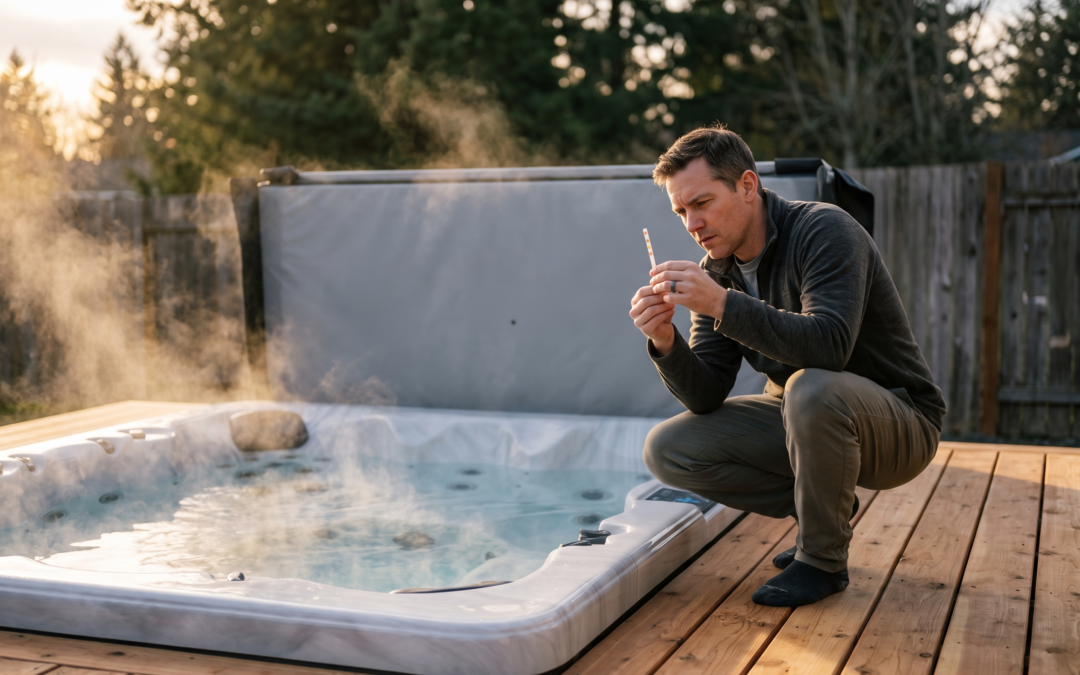
Of all the numbers on a test strip, pH is the one that quietly controls everything else. It decides whether your sanitizer actually kills germs, whether the water feels silky or stings your eyes, and whether your heater survives another season. Get it right and the rest of your routine gets easier; let it drift and you spend weeks chasing cloudy water, itchy skin, and short filter life.
The good news: correcting it is one of the simplest jobs in spa ownership once you know the order of operations. This guide covers both directions – raising the reading when water turns acidic and lowering it when it climbs too high – with dosing guidance, timing, and the mistakes that keep owners stuck in a cycle of overcorrection.
Key Takeaways
- The target range for spa water is 7.2 to 7.8, with 7.4 to 7.6 being the sweet spot for comfort and sanitizer performance.
- Always balance total alkalinity first — it is the buffer that holds your reading steady.
- Use sodium carbonate (soda ash) to raise the reading and sodium bisulfate to lower it, added gradually with the pump running.
- Small, repeated doses beat one large correction. Overshooting is the top reason owners bounce between products.
- Check the water twice weekly, and again after heavy use, rainfall, shocking, or topping off.
Understanding pH Levels in a Hot Tub
What Is pH and Why Does It Matter?
The scale runs from 0 to 14. Below 7 is acidic, 7 is neutral, above 7 is basic. Because the scale is logarithmic, each whole number represents a tenfold change, which is why 6.8 is far more aggressive than 7.8, even though they look close on a strip.
In a spa, that difference shows up fast. Acidic water pulls at metal, plastic, and adhesives, while alkaline water lets dissolved minerals stick to the tub as scale. In the middle, water is stable, comfortable on skin and eyes, and gentle on the shell and plumbing.
What Is the Ideal pH Level for a Hot Tub?
Aim for 7.2 to 7.8. The CDC recommends this range for home pools and hot tubs because it balances three competing priorities: germ-killing power, equipment lifespan, and bather comfort. Above 8.0, chlorine loses much of its ability to kill germs. Below 7.0, sanitizer works harder but pipes and heaters begin to corrode.
Most technicians narrow the target further to 7.4 to 7.6. Sitting mid-range gives you room to drift either way without crossing a threshold that causes problems.
How pH Affects Other Water Chemistry Levels
Nothing in a spa moves in isolation. Alkalinity acts as a shock absorber – when it runs low, your reading swings wildly from one day to the next. Calcium hardness determines whether a high reading turns into visible scale. Sanitizer efficiency rises and falls too, which is why the same 3 ppm of chlorine behaves very differently at 7.4 than at 8.2.
That is why balancing one number alone often fails to fix a water quality problem. Cloudy water might trace back to hardness, a saturated filter, or a sanitizer shortfall – with pH simply reflecting the imbalance rather than causing it.
Signs Your Hot Tub pH Is Too Low
Acidic water announces itself on your body first. Skin feels dry or itchy after a soak, eyes sting, and the water gives off a sharp chemical smell that owners often mistake for too much sanitizer when it is actually the opposite problem.
Behind the panels, the damage is quieter. Heater elements pit, jet hardware dulls, and seals harden – corrosion that builds over months and often surfaces as an unexpected hot tub repair bill. You will also burn through sanitizer faster, and readings will refuse to hold.
Signs Your Spa Water pH Is Too High
A high reading is a visual problem more than a physical one. Water turns cloudy or dull, and a fine mineral film appears along the waterline, on the heater, and inside the plumbing. Where fill water is hard, scale can restrict flow within a single season.
The bigger risk is invisible: sanitizer becomes far less effective above 8.0, so bacteria get a foothold even when your chlorine reading looks fine. Scale also clogs filter cartridges, which means weaker jets, longer heat-up times, and a pump working harder than it should.
Common Causes of Low and High pH Levels
| Cause | Low pH Impact | High pH Impact |
|---|---|---|
| Heavy rainfall | Dilutes water and lowers the reading | Rarely contributes |
| Frequent use | Bather contaminants may lower it | Can raise it depending on products used |
| Water source | Naturally acidic fill water | Naturally alkaline fill water |
| Chemical overuse | Excess pH decreaser | Excess pH increaser |
| Poor maintenance | Causes unstable water chemistry | Leads to buildup and scaling |
| High alkalinity | Usually not a factor | Often causes a persistently high reading |
Environment plays a larger role than most owners expect. Rain is mildly acidic, so an uncovered spa drifts downward after a wet week, while aeration from jets and blowers drives off carbon dioxide and pushes the reading up.
Identifying the pattern matters more than any single correction. If the number falls every Monday after weekend guests, the fix is a pre-soak rinse, not a bigger dose of product.
How to Increase pH in Hot Tub Water
Test the Water First With Test Strips or a Liquid Kit
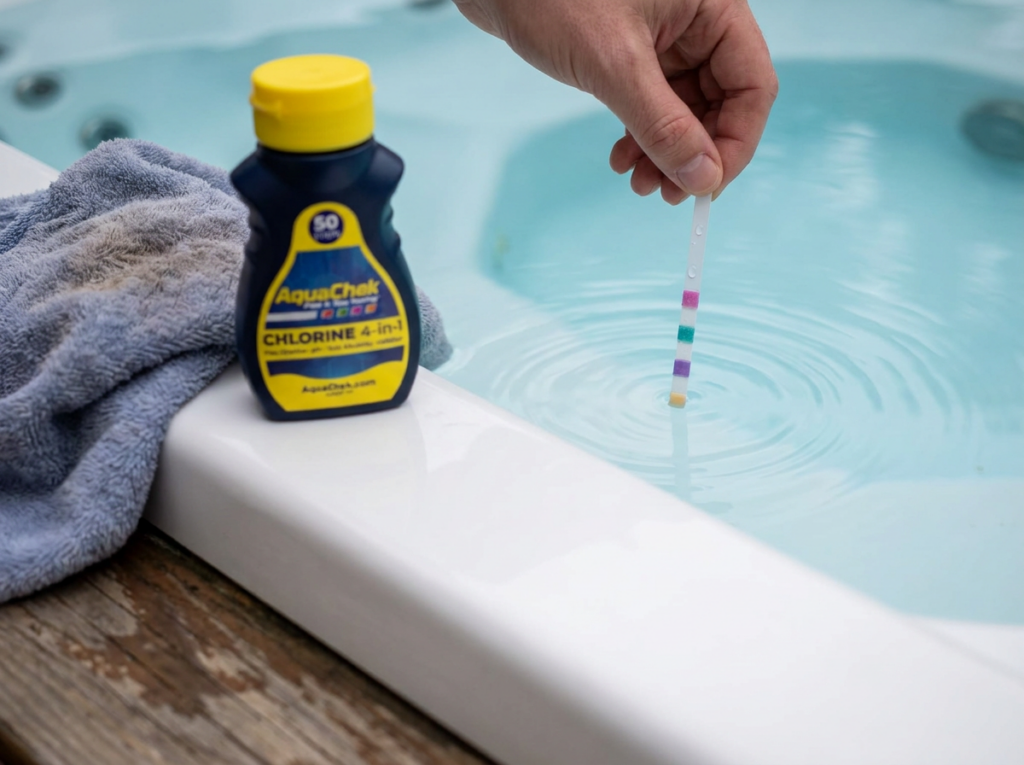
Never dose blind. Dip test strips away from a running jet, hold them level, and read against the label at the exact time the instructions specify. Liquid reagent kits take longer but give a more precise number, which is worth it when troubleshooting a stubborn problem.
Write down what you see. A baseline of pH, alkalinity, sanitizer, and hardness turns three weeks of readings into a trend line that reveals whether you have a one-off dip or a chronic imbalance.
Add a pH Increaser (Sodium Carbonate)
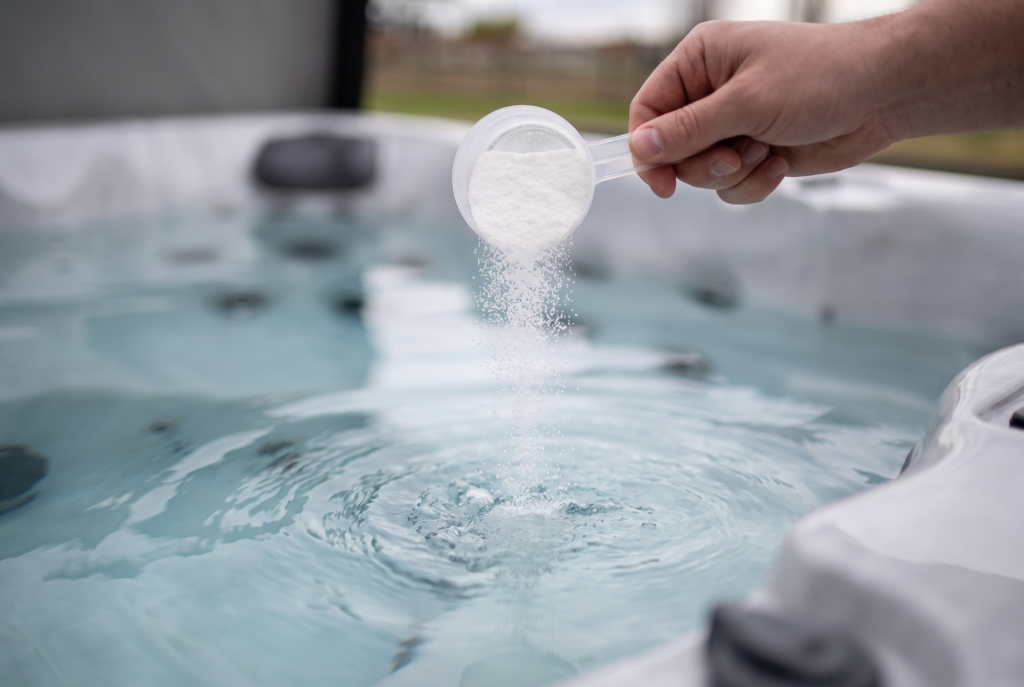
Commercial pH increaser is soda ash. Dissolved in water, it releases carbonate ions that neutralize acidity and lift the reading, usually with a modest bump to alkalinity alongside it.
Pre-dissolve the granules in a bucket, then pour slowly around the perimeter with the pump running and the air valves closed. Use the doses below as a conservative starting point, and always defer to your product label.
| Spa Volume | Starting Dose (pH Increaser) | Starting Dose (pH Decreaser) |
|---|---|---|
| 200–300 gallons | ½ tablespoon | ½ tablespoon |
| 300–500 gallons | 1 tablespoon | 1 tablespoon |
| 500–800 gallons | 1½–2 tablespoons | 1½–2 tablespoons |
| Swim spa (1,000+ gallons) | Dose by label per volume | Dose by label per volume |
Safety guidance from the Pool & Hot Tub Alliance is clear on the basics: never mix products together, always add product to water rather than water to product, and store containers sealed, dry, and separated.
Soda Ash vs. Sodium Bicarbonate: Which One Should You Use?
Both raise the reading, but they are not interchangeable. Soda ash moves pH sharply with only a small effect on the buffer. Baking soda does the opposite – 1 tablespoon per 100 gallons raises alkalinity by about 10 ppm while nudging pH up only slightly.
Choose based on what your strip shows. If both numbers are low, start with baking soda and retest; restoring the buffer often brings the reading back on its own. Household washing soda is chemically similar, but spa-grade granules are finer and free of additives.
Allow Proper Circulation
Chemicals need moving water to disperse. Run the pump on low for at least 20 to 30 minutes after any addition, and if possible, keep the cover open during that window.
Measuring too early is the most common source of confusing numbers, because you sample water that has not finished mixing.
Retest and Adjust Gradually
Check again after circulation and evaluate before reaching for the container. Aim for the middle of the range – landing at 7.5 gives you drift room in both directions.
If you are still short, add another partial dose rather than doubling up. Two measured corrections spaced 30 minutes apart are far easier to control than one large addition that overshoots into the 8s.
How to Lower pH in Spa Water
Use a pH Decreaser
pH decreaser is typically sodium bisulfate, sold as dry acid. The granular powder is safer to handle than liquid muriatic acid, which has no place in a residential spa. Apply it the same way: pre-dissolve, pour slowly with the pump running, air off. Wear eye protection and never add it alongside another product.
Add Chemicals in Small Increments
Sodium bisulfate lowers alkalinity along with pH, so a heavy dose can knock out your buffer and leave the water unstable. Start with roughly half of what you think you need.
Small increments also protect you from the overcorrection loop: too much acid drops the reading into the 6s, so you add increaser, overshoot, and repeat.
Monitor Water After Treatment
Check 30 minutes after circulation, then again several hours later once the water has equilibrated. The second reading is the honest one.
Look once more the next day before soaking. If the number climbed straight back up overnight, alkalinity is running high and needs attention first.
pH Increaser vs. pH Decreaser Comparison
| Factor | pH Increaser | pH Decreaser |
|---|---|---|
| Primary purpose | Raises acidic water | Lowers alkaline water |
| Common ingredient | Sodium carbonate | Sodium bisulfate |
| Used when | Below 7.2 | Above 7.8 |
| Benefits | Prevents corrosion and irritation | Prevents scaling and cloudy water |
| Application method | Added gradually with circulation | Added gradually with circulation |
| Common mistake | Adding too much too quickly | Overcorrecting and dropping too far |
Keep both on hand. Owners who stock only one tend to tolerate a bad reading for days rather than fixing it the same evening.
The Role of Total Alkalinity in pH Control
Alkalinity measures the water’s capacity to resist change – a buffer that absorbs acids and bases before they can move your reading. When it sits in range, pH stays put for days. When it runs low, the number bounces after every soak and every addition.
Target 80 to 120 ppm for most spas, or the range in your owner’s manual. Below 80 you get instability; above 150 you get a stubbornly high reading that resists correction. Adjust the buffer first, restoring balanced alkalinity often pulls pH back into range without separate treatment.
When to Use an Alkalinity Increaser
Reach for an alkalinity increaser – sodium bicarbonate – whenever the buffer tests below 80, regardless of what the other number is doing. Dose it, circulate 30 minutes, retest, and only then decide whether more work is needed.
If water alkalinity is too high instead, sodium bisulfate brings it down, though it takes patience: partial dose, circulate, aerate, and recheck across several days rather than forcing it in one session.
Mistakes to Avoid When Adjusting Hot Tub pH
Adding Too Many Chemicals at Once
Dumping in a full dose, or stacking two products back to back, creates unstable water that reads differently every hour. It also makes diagnosis impossible, since you cannot tell which addition caused which change. Treat every adjustment as a single variable: one product, one dose, circulate, recheck.
Ignoring Alkalinity Levels
If the reading keeps drifting no matter how carefully you dose, the buffer is the usual suspect – that is the classic pattern of water that looks correct on Sunday and wrong again on Tuesday. The reverse is also common: a high buffer locks the reading near 8.0, and no decreaser will hold it until alkalinity itself comes down.
Testing Water Incorrectly
Expired strips, surface samples, readings taken beside a jet, and measurements within minutes of an addition all produce numbers you cannot trust. Store strips sealed in a cool, dry place – humidity ruins a bottle quickly – and allow a full circulation cycle after any treatment before drawing a sample.
How Often Should You Test Your Water?
Most households should check the water two to three times per week, and spas serving four or more regular bathers benefit from a quick strip before every soak.
Season matters too. Wet months bring rainfall and frequent top-offs, while warm weather increases bather load and sanitizer demand. Add an extra check after a long soak session, a rainstorm with the cover off, shocking, refilling, or any adjustment.
Preventing Future pH Problems
Consistency beats correction. Five minutes on a fixed schedule – say, Wednesday and Sunday – catches drift while it is still a 0.2 adjustment rather than a full rebalance. Store products sealed and off the ground, and buy quantities you will use within a season, since degraded product doses unpredictably.
Rinse your filter cartridge every two weeks and deep-clean it monthly. A loaded filter restricts circulation, which lets chemistry stratify and readings vary across the spa. Keeping the buffer, hardness, and sanitizer in range does more for stability than any single product you can add.
When to Seek Professional Water Care Assistance
Some problems will not resolve at home. If the reading drifts out of range within 24 hours of every correction, if the buffer refuses to hold, or if water stays cloudy despite balanced numbers, something upstream is driving it.
A technician can identify what a strip cannot: high dissolved solids from water overdue for a change, metals in well-sourced fill water, biofilm inside the plumbing, or a failing component. Professional hot tub water care services diagnose the cause rather than treating symptoms week after week, and scheduled hot tub service catches corrosion, scale, and filtration issues while they are still inexpensive fixes.
Why Homeowners Trust Aqua Clear for Water Care
Aqua Clear has spent years helping owners move from reactive troubleshooting to a routine that simply works. Our team knows how local fill water behaves and how to read a set of numbers that do not add up.
We offer one-time balancing visits, recurring maintenance plans, and straightforward answers when you are standing over the water wondering what to add next. Preventative maintenance is where we deliver the most value: regular inspections, filter service, and balance checks stop the recurring issues that cost far more in repairs than in upkeep. Learn more at Aqua Clear Hot Tubs.
Conclusion
Balanced water protects three things at once: clarity, comfort, and the equipment you paid good money for. Keep the reading between 7.2 and 7.8, keep the buffer in range beneath it, and the rest of your routine gets noticeably simpler.
Check on a schedule, adjust in small steps, and give the water time to circulate before judging the result. When the numbers stop making sense, reach out to Aqua Clear — we will help you find the cause and get your water back to effortless.
FAQs
What happens if I use my hot tub before the pH stabilizes?
Soaking in freshly treated water can irritate skin and eyes, since undissolved product may still be concentrated in pockets. Wait until the water has circulated 20 to 30 minutes and a fresh strip confirms the reading sits between 7.2 and 7.8. After a large correction, allow a few hours.
Can baking soda increase pH in a hot tub?
Yes, but only slightly. Baking soda mainly raises the buffer — roughly 10 ppm per tablespoon per 100 gallons — with a small upward nudge to pH. If the buffer is already fine, soda ash is the better choice. If both are low, baking soda often fixes them together.
Why does my hot tub pH keep dropping after I adjust it?
A weak buffer is the most common cause; without it, nothing holds. Acidic fill water, rain entering an uncovered spa, heavy bather loads, and certain sanitizers all push the reading down. Correct alkalinity to 80–120 first, then reassess.
Should I adjust alkalinity or pH first in a hot tub?
Alkalinity first, every time. It stabilizes everything else, so correcting it often brings the reading back into range on its own. Adjusting while the buffer is out of range usually means repeating the same work a day or two later.
Does shocking a hot tub affect pH levels?
It can. Dichlor shock is mildly acidic and pushes the reading down over time, while non-chlorine shock and cal-hypo tend to raise it. Recheck 24 hours after shocking — this is one of the most overlooked causes of unexplained drift.