
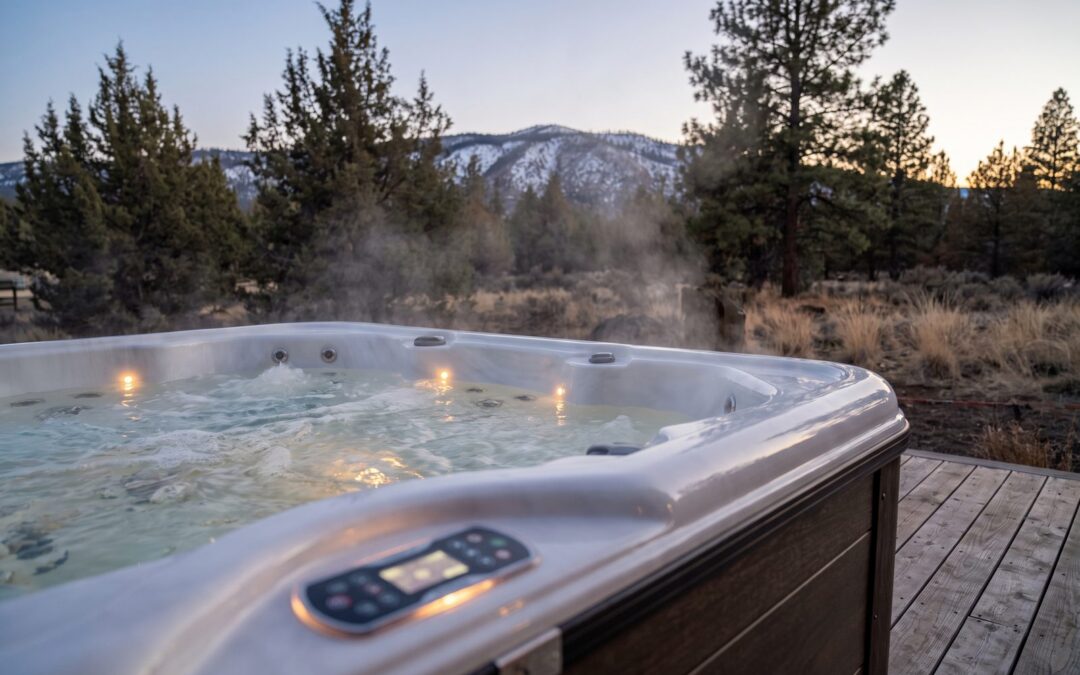
If you own a hot tub, or you’re close to buying one, you’ve probably asked the same question everyone asks: what temperature should a hot tub actually be? Most spas top out at 104°F, and it’s easy to assume the highest setting must be the best one.
It usually isn’t. The hottest setting isn’t automatically the most comfortable, the safest, or the most efficient. The right number depends on who’s soaking, how long they stay in, what the weather is doing outside, and how well your spa holds heat.
This guide walks through the recommended temperature ranges, the factors that shift your ideal setting, how to adjust between a Central Oregon winter and a dry July afternoon, and when a lower setting is genuinely the better call. At Aqua Clear Hot Tubs, we’ve spent years helping Bend and Sisters homeowners plan, install, and maintain spas that hold temperature reliably in a high desert climate. Temperature questions come up in almost every conversation we have.
Key Takeaways
- 100°F to 102°F is the everyday sweet spot for most adults: warm enough for real hydrotherapy, comfortable enough for a full soak.
- 104°F is the industry maximum, not a target. It’s a ceiling set for safety, and it suits short soaks in cold weather more than daily use.
- Soak time should go down as the temperature goes up. Pay attention to how you feel, not to a stopwatch.
- Season matters. Many owners run a few degrees warmer in winter and several degrees cooler in summer.
- Your cover and insulation affect efficiency more than your thermostat does. A worn cover wastes more energy than a couple of degrees ever will.
- There’s no universal energy-saving number. The best setting depends on your spa, your property, and how often you actually use it.
What Is the Ideal Hot Tub Temperature?
For most healthy adults, the commonly preferred range sits between 100°F and 102°F. That window is warm enough to relax muscles and support circulation, but not so hot that a 20-minute soak becomes uncomfortable.
It’s worth separating two different ideas here. The maximum allowable temperature for a residential spa is 104°F, a hard cap built into the equipment. The ideal temperature for everyday use is something you choose inside that limit, and it’s almost always a few degrees lower.
What shifts the number? Who’s using the tub, how long they plan to stay in, the outdoor conditions, whether they’ve just exercised, and any health considerations they’re managing. A 45-minute soak on a mild May evening and a 12-minute soak at 20°F in January call for genuinely different settings.
| Hot Tub Temperature | Best Use / Consideration |
|---|---|
| 95°F to 98°F | Longer, leisurely soaks and warmer weather |
| 99°F to 101°F | Comfortable everyday relaxation |
| 102°F to 104°F | Shorter adult soaks in colder conditions |
| 104°F (maximum) | The upper limit, not necessarily appropriate for routine use |
Why 104°F Is Not Always the Best Setting
Plenty of new owners set their spa to the max on day one and never touch it again. The logic makes sense on the surface: it’s a hot tub, so hotter must be better.
In practice, comfort and safety are two separate considerations, and 104°F serves neither especially well for routine soaking. At the top of the range, most people start feeling flushed and restless within 10 to 15 minutes, which cuts short exactly the relaxation they got in the water for.
There’s an ownership angle too. Holding water a couple of degrees lower generally means the heater works less to maintain that set point, which can trim heating demand over a season without meaningfully changing how the soak feels. For a lot of Central Oregon homeowners, 101°F year-round turns out to be the setting they never want to change.
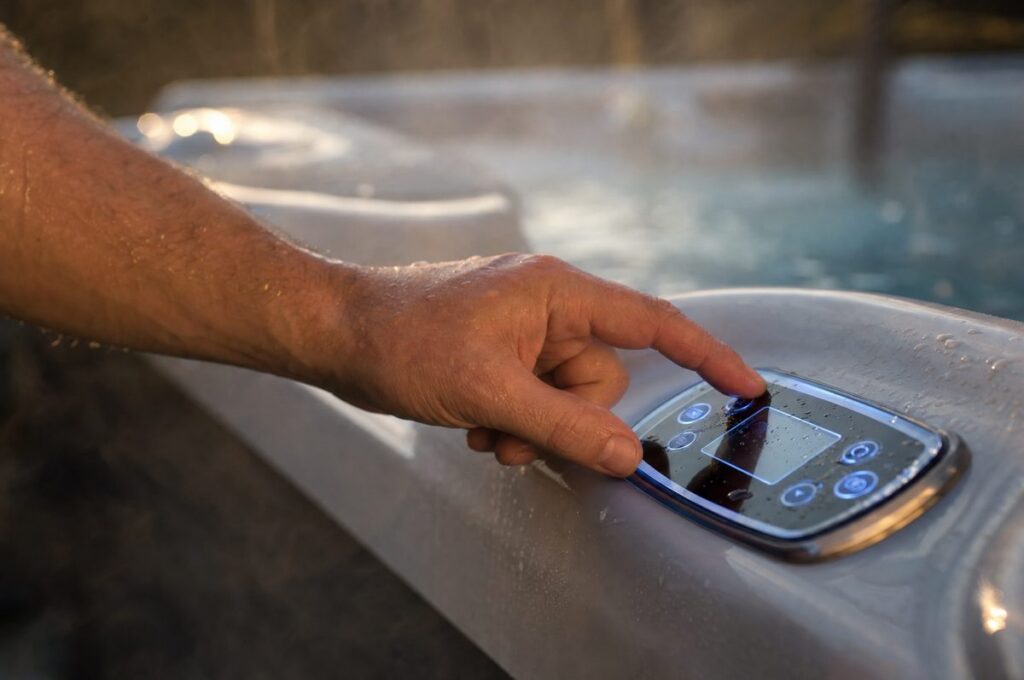
Hot Tub Temperature and Safety: What You Need to Know
Warm water affects the body differently than an ordinary bath does. You’re immersed for longer, the water stays at a constant temperature instead of cooling, and submersion makes it harder for your body to shed heat through sweating. That combination is what makes a long soak at a high setting more demanding than it feels.
This is why the 104°F limit exists. The U.S. Consumer Product Safety Commission has long advised that hot tub water temperatures should never exceed 104°F, and virtually every modern spa is built so you can’t set it higher.
Always follow your spa manufacturer’s temperature limits and safety instructions. They’re specific to your equipment, and they take priority over any general guidance, including ours.
Some people need extra caution: young children, older adults, anyone who is pregnant, and people managing heart conditions, blood pressure issues, diabetes, or medications that affect circulation or heat tolerance. If that describes you or someone in your household, talk with a healthcare professional about what’s appropriate before making hot tub use a regular habit.
How Long Should You Stay in a Hot Tub?
The practical rule: as the water temperature goes up, soak duration should come down. A relaxed 30 minutes at 99°F is a very different experience from 30 minutes at 104°F.
Rather than watching a clock, watch how you feel. Get out of the water if you notice dizziness, nausea, headache, excessive sweating, a racing heartbeat, or that lightheaded feeling that tells you you’ve had enough. Those signals are worth respecting immediately, not pushing through.
We’d avoid giving you a single number that’s “safe for everyone,” because it doesn’t exist. Tolerance varies with age, hydration, fitness, medications, alcohol, and how warm you already were when you got in. Start shorter than you think you need, drink water before and after, and let experience tell you what your comfortable duration is.
Hot Tub Temperature and Children
Children heat up faster than adults do. They have more skin surface relative to their body mass, less developed temperature regulation, and they’re far less likely to notice or mention that they’re overheating.
For that reason, adult temperature settings shouldn’t be treated as appropriate for kids, and constant adult supervision is essential any time children are in or near the spa. Many families drop the setting noticeably for family soaks and keep them short.
Check your manufacturer’s guidance on minimum ages and recommended settings, and ask your pediatrician about what’s appropriate for your child specifically. That’s a better source than any general article, including this one.
The Best Hot Tub Temperature for Different Uses
The clearest way to land on your number is to ask what you’re mostly using the spa for. Someone who soaks for 40 minutes with a book wants something different from someone decompressing for 15 minutes after skiing Mt. Bachelor.
| Hot Tub Use | Temperature Strategy | Key Consideration |
|---|---|---|
| Relaxation | Comfortable moderate setting (100°F to 102°F) | Prioritize comfort and soak duration |
| Cold-weather soaking | Warmer setting (102°F to 104°F) | Account for outdoor temperature and wind |
| Warm-weather use | Lower setting (95°F to 99°F) | Prevent overheating |
| Longer soaks | Lower to moderate setting | More comfortable over extended periods |
| Post-exercise recovery | Moderate setting | Consider individual tolerance and recovery goals |
| Family use | Conservative setting | Account for different users and ages |
How Outdoor Temperature Affects Your Ideal Hot Tub Setting
Air temperature, wind, humidity, and how exposed your spa is all change two things at once: how the water feels to you, and how hard the spa works to hold its set point.
Central Oregon makes this obvious. Our high desert climate swings 30 to 40 degrees between afternoon and night, winter air is dry and cold, and an unprotected backyard in Sisters or on Bend’s east side can catch serious wind. Water that feels perfect at 100°F on a still September evening can feel underwhelming at the same setting when it’s 18°F with a breeze.
One thing worth knowing: dropping the thermostat dramatically every time you’re not using the tub isn’t automatically the efficient move. Energy use depends on your spa’s insulation, your cover, the weather, and your usage pattern, and recovering from a large drop takes real energy. For frequent users, a steady setting is often the smarter play.

Ideal Hot Tub Temperature in Winter
Cold weather is when insulation and cover condition stop being minor details. A well-insulated cabinet and a tight, properly fitted cover are what keep a winter soak affordable. The thermostat setting is a much smaller lever than most owners assume.
If you use the spa regularly through winter, maintaining a consistent temperature is usually the better approach than cycling it up and down. Many Bend owners settle around 102°F from December through March and leave it there.
If you’re traveling for a stretch, a modest reduction can make sense. But never shut a spa down or let it go cold in freezing weather unless it’s been properly winterized and drained. Freeze damage is far more expensive than the energy you’d save. This is also where installation quality shows up: placement, a level foundation, wind protection, and correct electrical work all feed into how well a spa holds heat in January.
Ideal Hot Tub Temperature in Summer
When it’s 88°F outside, 104°F water is a lot. Most owners find that a cooler setting, somewhere in the mid to high 90s, is far more pleasant in July, and it lets you stay in longer without overheating.
Some people go cooler still and use the spa almost like a plunge pool on hot afternoons. Just stay within your manufacturer’s recommended operating range; going below it can affect water chemistry and, on some models, how equipment operates.
How to Choose a Temperature That Balances Comfort and Energy Efficiency
Your operating cost isn’t set by the thermostat alone. It’s the combination of your set point, how often the heater cycles, outdoor conditions, cabinet insulation, cover quality, and how much you actually use the spa.
Which is why there’s no universal “energy-saving temperature.” A well-insulated spa under a new cover in a sheltered Bend backyard behaves nothing like an older tub with a waterlogged cover sitting exposed to west wind.
A framework that works: start with how often you use it, then the season, then your typical soak length, then current weather, then your insulation and cover condition, and adjust from there. Change one variable at a time and give it a week.
Does Lowering the Temperature Save Money?
The underlying principle is straightforward: holding water at a lower temperature generally requires less heat input, because the gap between your water and the outside air is smaller. A spa held at 99°F loses heat more slowly than the same spa at 104°F.
The complication is that repeated large drops change the heating pattern. Every time you let the water fall 10 degrees and then bring it back, the heater runs a long recovery cycle. Do that often enough and you can erase the savings you were chasing.
Focus on your real schedule instead of fiddling with the dial. If you soak three nights a week, pick a comfortable setting and leave it. If you’re a weekends-only owner, use your spa’s energy-saving, sleep, or scheduling mode if it has one, so the water is ready when you want it without holding full temperature all week.
2 Factors That Can Change Your Ideal Hot Tub Temperature
Personal comfort, weather, soak duration, how often you use the spa, tub size, insulation, cover condition, and location all pull your ideal setting in different directions. That’s why two neighbors with identical spas can land three degrees apart and both be right.
Treat temperature as an adjustable setting, not a fixed rule. But if you want the two factors with the biggest practical impact on comfort and cost, they’re these.
1. Hot Tub Cover and Insulation
A high-quality, properly fitted cover is the single most effective thing standing between your heated water and the outside air. Evaporation is the largest source of heat loss in any heated body of water, which is why a cover that seals properly does more for your energy bill than any thermostat adjustment. Swim University’s guide to hot tub covers in cold climates goes deeper on insulation ratings and what to look for.
Evaporation is the biggest source of heat loss, and a good cover stops it.
Covers wear out. Watch for a cover that has become waterlogged and heavy, has torn vinyl or a split hinge seam, sags in the middle, or no longer seals flush along the edges. Any of those means heat and moisture are escaping continuously.
Think of cover replacement as a cost-of-ownership item rather than an optional upgrade. Homeowners frequently respond to rising energy bills by turning the temperature up, when the actual fix was a $500 cover.
2. Placement and Installation
Where the spa sits shapes both the experience and the energy math. Wind exposure strips heat from the cover and makes getting in and out miserable in winter. Distance from the house affects how often you actually use it. Foundation, drainage, and access affect everything from equipment longevity to whether a technician can service it.
These are much easier to get right before delivery than after. A professional site assessment is how we sort this out. Ours specifically evaluates placement, access, electrical requirements, and foundation needs so there are no surprises on installation day. If you’re still in the planning stage, our step-by-step hot tub installation guide covers what to expect.
Hot Tub Temperature Mistakes to Avoid
- Setting it to maximum by default. Higher isn’t better. 104°F is a ceiling, not a recommendation, and it shortens most people’s comfortable soak time.
- Ignoring the season. The setting that’s perfect in January is often several degrees too warm in July. Adjust twice a year and you’ll enjoy the spa more.
- Changing the temperature constantly. Chasing the dial usually costs more than it saves. Build a setting around your actual usage schedule and leave it alone.
- Neglecting water chemistry. Temperature management doesn’t replace testing, cleaning, and balancing. Warm water is exactly the range where bacteria grow best, so sanitizer levels matter more, not less.
- Ignoring the cover. Heat loss through a failing cover gets blamed on the thermostat or the heater constantly. Check the cover first.
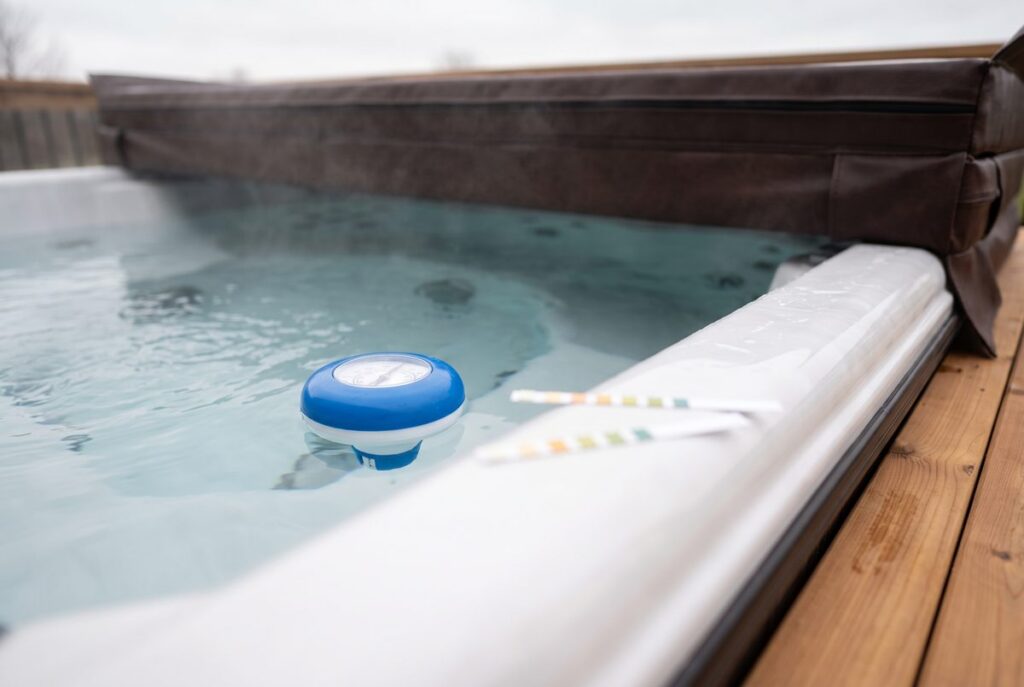
How Proper Maintenance Helps Maintain the Right Temperature
Clean filters, balanced water, and properly functioning components are what let a spa hold its set point reliably. A clogged filter restricts flow, which makes the heater work harder and can trigger flow errors. The symptom you notice is water that won’t come up to temperature.
Water care matters for health reasons too, not just equipment. The CDC notes that hot tubs operate within the temperature range where Legionella grows most readily, and that warm water accelerates disinfectant loss. That’s exactly why consistent sanitizer and pH management is non-negotiable.
A workable routine looks like: test water two to three times a week, balance sanitizer and pH, rinse filters monthly and deep-clean them quarterly, wipe the waterline, and drain and refill every three to four months. Our complete hot tub maintenance guide walks through the full schedule.
If you’d rather not manage it yourself, our hot tub maintenance services cover weekly, bi-weekly, or monthly care, plus one-time service visits and repairs.
When Temperature Problems May Indicate a Bigger Issue
Some temperature behavior is normal. A spa recovering from a refill, or from a long soak with the jets and blower running on a cold night, will take time to come back up.
These signs are worth attention: unusually slow heating, water that never reaches the selected temperature, temperature that swings without explanation, a heater that cycles constantly, or persistent error codes on the topside panel. Those often point to a filter, flow, sensor, or heating element issue rather than a thermostat setting.
Check the simple things first: filter cleanliness, water level, cover condition, and jet settings. Beyond that, don’t troubleshoot electrical components yourself. Spa wiring carries serious risk, and diagnosing heaters, sensors, and control boards is work for a qualified service technician.
A Simple Hot Tub Temperature Guide for Everyday Use
Here’s the at-a-glance version, worth a screenshot for the next time someone in the house asks what to set it to.
| Situation | Temperature Approach |
|---|---|
| Frequent daily use | Maintain a consistent, comfortable setting (100°F to 102°F) |
| Occasional weekend use | Consider a planned temperature schedule or energy-saving mode |
| Very cold weather | Prioritize heat retention, cover condition, and freeze protection |
| Hot summer weather | Consider a lower, more refreshing setting (95°F to 99°F) |
| Longer soak | Use a more conservative temperature |
| Multiple users or mixed ages | Choose a setting appropriate for everyone in the tub |
The through-line: pick a comfortable, safe setting inside your manufacturer’s limits, then adjust it for real-world conditions instead of hunting for one universal number.
When to Ask a Hot Tub Professional for Help
Some of this you can sort out with a week of experimenting. Other situations are worth a conversation: choosing a spa with insulation that suits our climate, determining placement on a sloped or windy lot, preparing electrical service, diagnosing a heating problem, or building a maintenance plan you’ll actually keep up with.
Aqua Clear has spent 15+ years walking Central Oregon homeowners through the entire process, from the first showroom visit to service calls years later. Our team knows what holds up through a Bend winter and what doesn’t, because we service these spas locally. You can read more about our hot tub specialists and how we work.
If you’re not sure which spa, which temperature strategy, or which installation setup fits your property, that’s exactly the kind of question we’re happy to talk through. No pressure, no obligation.
Conclusion
The ideal hot tub temperature isn’t one number. It’s a balance between comfort, safety, how you use the spa, what the weather is doing, and how efficiently your equipment holds heat. For most people that lands between 100°F and 102°F, but the value of knowing why is that you can adjust with confidence instead of guessing.
Stay inside your manufacturer’s limits, make seasonal adjustments deliberately rather than daily, keep your water balanced and your cover in good shape, and bring in a professional when installation or equipment questions come up.
Ready to talk it through? Stop by our showroom in Bend or Sisters for a test soak, or reach out about installation guidance and ongoing maintenance. We’d love to help you find the setup, and the setting, that fits your backyard.
FAQs
How long does a hot tub take to reach the ideal temperature?
Most residential spas heat at roughly 3 to 6 degrees per hour, so a fill from cold tap water can take 8 to 24 hours depending on the model, heater size, ambient temperature, and whether the cover is on. Recovering a few degrees after a soak typically takes under an hour. Keeping the cover closed during heating makes a noticeable difference.
Should I turn my hot tub temperature down when I go on vacation?
For a trip of a week or more in mild weather, lowering the setting or using your spa’s energy-saving mode is reasonable. In freezing conditions, never shut the spa off or let it go cold unless it has been properly drained and winterized. Freeze damage costs far more than the energy saved. For short trips, leaving it at your normal setting is usually simplest.
Why does my hot tub temperature keep fluctuating?
The most common causes are a dirty filter restricting flow, a low water level, a worn or poorly sealing cover, or running jets and the air blower for long stretches in cold weather. If those check out and the temperature still swings, it may be a flow or sensor issue that warrants professional inspection.
Can I use a hot tub when it is below freezing outside?
Yes. Winter soaking is one of the best parts of hot tub ownership in Central Oregon. Keep the spa running and heated rather than shutting it down, make sure the cover seals well, clear snow from the cover and access path, and keep soaks a bit shorter since the contrast between water and air is significant. Have a robe and slippers within reach of the steps.
Does a hot tub use more electricity when the temperature is set higher?
Generally yes. A larger gap between water temperature and outside air means faster heat loss, so the heater runs more to maintain the set point. That said, insulation quality, cover condition, weather, and usage patterns influence your bill at least as much as a two or three degree difference in your setting.